Winter Prep with Anne Frey (309)

 Apple Podcasts

 YouTube

 Spotify

 Amazon Music

 Overcast

 Castro

 RSS Feed
What exactly are honey bees doing inside the hive all winter? Following their recent discussion about condensing hives, Dr. Jim Tew and Anne Frey return to the fundamentals of wintering honey bees. They begin with the temptation to judge bee comfort by human standards. A cold wooden box may look miserable to us, but honey bees have evolved a remarkably effective system for surviving long periods of cold weather.
Anne and Jim explore how the winter cluster expands, contracts, moves upward through stored honey, and circulates bees between its warmer interior and colder outer shell. They also discuss elevated CO2 levels, insulation, and why observing the cluster without disturbing it remains difficult.
The conversation turns practical as they consider what beekeepers can still do once winter begins. Adding top insulation, supplying honey, and carefully timing oxalic acid treatments may still be possible, but opening a colony for major manipulation can cost bees and disrupt the cluster.
Jim and Anne also look at winter moisture, how bees access thick stored honey, cleansing flights, and what snow around a hive can reveal about colony activity.
Winter may look quiet from the outside, but inside the hive, the colony is anything but inactive.
______________________

Thanks to Betterbee for sponsoring today's episode. Betterbee's mission is to support every beekeeper with excellent customer service, continued education and quality equipment. From their colorful and informative catalog to their support of beekeeper educational activities, including this podcast series, Betterbee truly is Beekeepers Serving Beekeepers. See for yourself at www.betterbee.com

We'd like to thank Vita Bee Health for supporting the podcast. Vita provides proven tools for controlling Varroa—from Apistan and Apiguard to the new VarroxSan extended-release oxalic acid strips—helping beekeepers keep stronger, healthier colonies.

Thanks to Bee Culture, the Magazine of American Beekeeping, for their support of Honey Bee Obscura. Available in print and digital at www.beeculture.com
______________________
Honey Bee Obscura is brought to you by Growing Planet Media, LLC, the home of Beekeeping Today Podcast.
Music: Heart & Soul by Gyom, All We Know by Midway Music; Christmas Avenue by Immersive Music; original guitar music by Jeffrey Ott
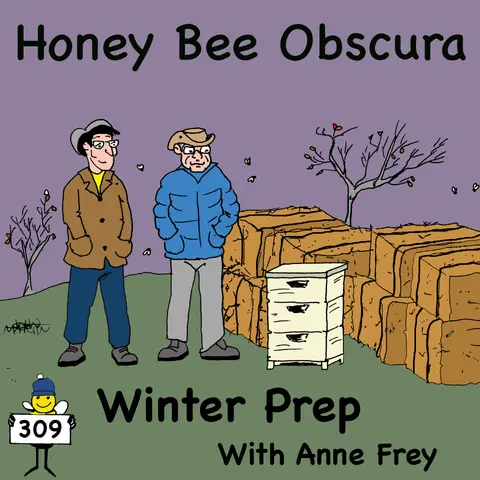
Episode artwork created by Jeff Ott with ChatGPT by OpenAI. (Jim's regular cartoonist, John Martin, is on vacation and will be back!)
Copyright © 2026 by Growing Planet Media, LLC

0:01 Listeners, here's some behind the scenes info. Anne Frey and I spent some time talking about this concept of the condensing hive. And we kept stepping on basic wintering concepts. So it was suggested to us that we discuss basically what's happening in the winter, how the bees are performing, why we would consider something like insulation. At all, and that's what we're going to do. Anne's here with me, Anne Frey from Betterbee. Say hi Anne. Hi, everybody. And I'm Jim Tew. I come to you here once a week at Honey Bee Obscura, where today Anne and I are going to try to talk about something to do with just plain talk wintering.
0:44 Welcome to Honey Bee Obscura, brought to you by Growing Planet Media, the producers of the Beekeeping Today podcast. Join Jim Tew. Your guide through the complexities, the beauty, the fun, and the challenges of managing honey bees. Jim hosts fun and interesting guests who take a deep dive into the intricate world of honey bees. Whether you're seasoned beekeeper are just getting started. Get ready for some plain talk that'll delve into all things honey bees. And in other segments you and I have discussed, I guess, the concept of anthropomorphism where we abscribe human characteristics to non-humans.
1:28 Our bees sting because they're angry. They buzz when they're happy. We keep giving them personality attributes And I'll sit in my house, I keep it around 68 , I'll have a light sweater on, and I'll have a throw over my feet, and I'm thinking my bees are out in that wooden box all by themselves. No central heat system, nothing. It must be terrible. I should do something. And then I began to think about these insulation concepts and Additional heat. What do you think about the whole business of wintering? Are bees happy with being in a cold climate And surviving the big dearth? Well, it's not their natural thing for sure.
2:11 I mean they came from tropical areas. back when they were evolving, but they evolved quickly because they're insects. They, you know, short little lifespans. They've developed this system of hunkering down and allowing a lot of carbon dioxide to build up around them and uh that's an insect thing across a lot of different insect species is it helps them to be dormant to have all that CO2. So just a different physiology. They've they can get through the winter with cold weather constantly. They just they cluster in a specific way.
2:51 We insulate the top of the hive heavily and that helps. I love thinking about the shape of their cluster and what that's doing. You know what I mean It's kind of an oval, isn't it? How would you describe the cluster shape? When we look at it from the outside, it's you know, a ball or an oval, depending on how it's if it's a little bit warmer outside that ball or oval egg shape is expanding, you know, 'cause they're loosening up the distance between themselves, but if it gets real cold it's gonna be kind of a tight cluster, right? Who was it? Somebody did a test. Somehow he was filming the bees and he had like lightly covered the outside of the cluster with spray paint And he could observe how those bees flowed from the outer shell into the middle and then back out again and it was more like a more like a fat donut sort of thing than just an egg shape.
3:56 It was like 'cause they'd flow upwards is it upwards on the outside or upwards on the core of it? I'm going to have to let you go with that. I'm s I'm still you've still got me thinking about this oval shape. I was thinking about the eye of a hurricane Yeah, it's like a storm. It it's like uh it's got a cycle. The heat's being generated in the outer rings of the cluster like the outer rings of a hurricane spinning air, but it's you know this I don't know. That's not a good analogy, but the cluster seems to have an eye where the brood is and they tend to put their heads in too, so their little cold butts are all sticking out So when you look at a cluster all you look at is bee buds, because their head, apparently, is the warmest part of them and gives off the most heat.
4:43 They do those kinds of things to be as efficient as possible I would definitely say the heat is produced on the inside of the cluster and the ones on the outside they're they're very still, they're very chilly. They're the insulating bees. They're very tight together, like kind of a shell around them. Somebody I think it was David wrote something about the cluster of the bees and he said to picture it like the shape of the fluid inside of a blender, like it's doing that turnover thing, but then there's also the center. So all these images and also the cluster rises slightly during the winter slightly more. You know, it's they're nibbling on their honey and passing it to each other then there's no honey just above them.
5:29 So they you know, they move up a bit. So it's expanding, it's contracting, it's moving upwards, it's doing this this blender thing to cycle the cold bees into the middle and get different ones to become the ones on the outside for a while. It's just so cool. The thing that comes to mind immediately is that it's also not only cool but also mysterious because it's always inside a hive and when you open it's like some kind of thermonuclear dynamics or something when you stop the motion Then you stop the action. So when I open the colony up, then it's no longer in a natural wintering state. It's me with the top off looking at it.
6:11 So you never really know From my perspective, the inner workings and secrets of that cluster mechanism. You have to depend on the others who use glass wall hives and interior cameras and sensing devices. I can't do all that. You know those little cameras are really cheap now though. I'm getting ideas about how to put some of them in a hive and then you can get the info from them wirelessly My friend Jay is doing that kind of stuff now. He says they don't interfere with each other. You could put multiples inside the hive. I think they're like each one is only twenty five dollars. Just these little spy cameras that used to be James Bond uh Oh yeah yeah yeah.
6:53 Wouldn't that be fun? That would be fun. I bought a camera for inspecting tubing, like uh home down spouts It's got a long cable on it and you can turn the camera angle so that it looks straight or looks up or whatever. And I thought I want to just have this thing in a hive all the time. And all I've done was play with it here in the shop, looking under the couch and whatever. But I'm going to do it one day. You just wait. It sounds like it's the next best thing to an observation hive. This winter thing what happens, I wonder Like when I was in South Alabama. Bees do the same thing. They just do it more conveniently. They do it more easily in my experience.
7:34 They have more free fly days. And by having more free fly days they consume more honey on those free fly sorties when there's nothing to collect out there. Yeah they're flying but they're not bringing in any nectar. They're not bringing any nectar in. So people in the south do feed a lot more sugar syrup, you know It's just a natural thing to have to begin feeding shortly after the harvest and keep feeding until the wha when would spring be, like late January? Late January, early February where I was. There really was no winter. It was just but that's a a long time ago. This whole the winter thing is intriguing to me because once it starts, there's not really much you can do to correct a mistake.
8:20 One time you said you could add insulation late. There's never a bad time to add more insulation on the top. If they're hungry, you know, it's tough to add frames of honey. I know sometimes people, strangely, they say, I'm saving this honey in my garage in case the bees need it. It's like, well just give it to them. You know, give Give them that box of honey. Uh flop a box of honey on top, a box of frames full of honey. It's way easier than trying to insert some different frames, 'cause those frames are hard to move in the winter. But you know, what else can you do? You can do wintertime, uh wintertime oxalic acid dribble or vape, uh, you know, kill those last few mites.
9:05 That's a thing you can do. And it's not gonna hurt the bees to have it open for one to two minutes, that's how long it takes to do an OA treatment dribble. The vape is way more expensive, but you don't open it at all, so that's attractive to some people. Just the gear is expensive. I wanna say that Tom Seeley's book I think it's called Buzz Runners and Piping Hot Bees. Yeah, I th I think I think I've got that book. People should check that out to understand this winter cluster thing and he has such a great way of writing to to make it all visually understandable. Well, winter's coming Winter is coming.
9:47 If you're going to do anything, especially in the climate we're at and more north northern, you need to be doing it right now because the more you do, like you said, open it for two minutes, but if you're trying to pull frames out and add honey beside them, you really agitate the bees. And every bee that flies out and tries to defend the cluster is never going to get back. It's a one way trip. So when you walk away from it, there's three hundred dead bees in the snow all around you. You'd have to really wonder if what you just did was worth it or not to that waning cluster. If you're gonna have to add any winter food or do a oxalic acid treatment You gotta plan your moves out ahead of time and have everything right there.
10:32 Have your veil on because they will fly up and even in the cold they'll fly up because they are warm. And you know, make it as as quick and efficient as you can. It really helps to have a second person with you too. Well they start to cluster around what? Fifty-seven degrees is when the cluster begins to define itself Yeah, they're not gonna come out the door any lower than that. You know, maybe a few will, but the vast majority of 'em are they're kind of hunkering down. Below 38 or 39, they really are clustered. They're seriously tightening that cluster down and being very quiet. I don't want to do an oxalic acid treatment if it's below 40 because I want a kind of loose cluster and they start loosening up above 40.
11:22 But they're not gonna come out and fly out the door until it's above fifty-seven, fifty-eight. that it must be a long, boring winter. They're in the dark, it's cold, there's no television. All they're doing is rotating in the insulating shell and the bees inside are generating heat. It just seems like from my perception of a quality of life, it's it's a boring life. There's just Nothing to do but to hang on in this darkness. You know, how how exciting is the life of a deer or or a you know, a chipmunk or something.
12:06 It's like go out, eat Go back home, sleep. Avoid cats. Yeah. Eat more. I'm sorry you brought that up because a bit ago when we were talking all, you know, getting all sappy about bees and whatever. I'm thinking every animal out there, no matter how bad the weather is, no matter how cold and how much snow, those animals are still out there. I ride by a pond going down to Columbus. And maybe two times out of ten, there's a bald eagle that's been sitting above that pond for the last twenty years. And I think that eagle has never spent a single night indoors. It's always sat on limbs somewhere, maybe under a shelter of, you know, a natural shelter, but No matter how cold it is, those animals are out there surviving it.
13:05 They kind of make a big pile, chickadee pile in some kind of a cavity or birdhouse or something So they're you know, they're just so small and fragile, you know, they're if they're not migrating they're they're adapted to live here in the winter You know, before we get back to the bees, I've gotten all carried away here. Let's take a break and hear from our sponsor. For more than 45 years, Better Bee has proudly supported beekeepers by offering high-quality, innovative products, providing Outstanding customer service, many of our staff are beekeepers themselves, and sharing education to help beekeepers succeed.
13:46 Based in Greenwich, New York, Betterbee serves beekeepers all across the United States. Whether you're just getting started or a seasoned pro, Betterbee has the products and experience to help you and your bees succeed. Visit betterbee. com or Or call 1-800-632-3379. Better Be, your partners in Betterbee Keeping. We'd like to thank Vita Beehealth for supporting this podcast. Vita provides proven tools for controlling Varroa, Apistan, and Apiguard to the new VarroxSan extended release oxalic acid strips, helping beekeepers keep strong.
14:36 Alright. Sorry, sponsor. I've got excited about this discussion here. Alright, back to the bees clustering and not clustering. As it warms up, these bees will begin to break the cluster, loosen it And they're just letting heat escape. And we talked about moisture in that condensing hive, but that cluster needs moisture. I wish you could help me understand. how a bee, a worker bee, can eat essentially frozen honey. It absolutely won't pour And I've never understood, does the cluster warm the honey enough that it has a slightly liquid state to it? Or do they really need water?
15:23 Yeah, it's both of those things really. You know, people have said the the bees don 't heat the hive. They only heat the cluster, but you know, that's as a rule, the heat is near the cluster all that air up in the corners, it's as cold as the air outside is all winter. But there's a little room just around the cluster that's a little warmer. So yeah, that kind of umbrella of honey closest to them is a little bit warmer. And they do lick up water that has come from their breath and condensed on surfaces and that that helps them to get at the honey.
16:04 I not not sure if it's like saliva, but that's a that's a good way to think of it. But yeah, they're they get thirsty. That that stuff is almost a solid item honey is they need to thin it out and get some moisture into it to really use it. Well they have to have humidity inside the hive too because the brood requires a specific humidity level. There's really a need for moisture in the hive. While you were talking, I was wondering how long can a cluster go and a hard freeze, let's just say for a week. Because this insulating bees can't leave the cluster to go over to that dripping water and take a drink.
16:47 So the I guess they can only take water anywhere when it's warm enough for them to leave the cluster. Yeah, I think that's right. Yeah. So a hard freeze, I know that we've had hard freezes that lasted a week or more and, you know, down below twenty constantly, night and day, and the bees come through the winter So somehow they do it. I don't know. I'm sure they can use metabolic water to a degree so long as they're undergoing digestive processes, but I'm I'm beyond my ability now. I don't know that for a fight, but it seems like it would be something they could do. The main thing is they basically gang up and share communal body heat and just wait to get through the winter on a food source that they probably keep ever so slightly heated with the frequent need for moisture in the form of liquid moisture and humidity To maintain the levels that they want inside the hive.
17:52 And they're passing honey to each other, you know, anybody who gets a a nibble is their habits are just to always keep you know, they're touching each other, they're sh they're sharing their heat just through contact, they're passing food to each other. It's just just the way bees live. Well, there's an issue that's kind of repugnant, but it's important. They generate byproducts and they have to store those byproducts and this large rectal sac that they have. Ah, byproducts. Yep. Residue. And then come cleansing day. Heaven forbid you don't have your car nearby.
18:34 Because it's going to be peppered. My neighbor one day came over and said, These damn birds I never see them doing it, and they must be small birds, because it's little spots. And I f I have always wondered when do you tell all the truth, some of the truth, or none of the truth Yeah, those little brownish-yellow spots. The old B books used to say something like about putting your washing out to dry and it's just like, well that's hardly ever done nowadays, but Yes. Little spots all over the cars. That's definitely a thing. Or on the top of your your hat when you're doing any bee work out in the very early spring, you're spattered with this stuff.
19:18 But yeah, they gotta get out anytime it's a little bit one hour on a January day or something that's like above sixty and they all wanna come out and go to the bathroom 'cause they've been holding it. Can you imagine I can't imagine. And those I'm sorry folks, you folks who don't have snow, when you've got a good coating of snow on the ground after a flight day, there's just yellow drops everywhere And then there's frequently poles about the diameter of your finger, and at the bottom of that hole is a dying bee. that made a trip out, you know, like not going to return to the hive, clear the nest out. So there's all kinds of activity that happens on those flight days that you can see in the snow that you don't see If you don't have snow.
20:06 Yeah, those bees in their little pits, you know, clearly it was a warm bee that fell and then sunk down through the cold snow and that's sad. I think it happens accidentally sometimes, but I like to say like if you see a bee just at the top, that was a dead bee that a live one dropped, because you know, it landed, it was cold, it didn't sink. But the live ones they made a uh warm pit and sunken you know, there's also the weirdness that sometimes they fall on their backs on the snow or on the top of the hive and they can't seem to do anything, like they're still trying to fly, and I've heard that it's because everything is so bright and they think they're flying upwards towards the sky, but they're actually upside down and they c it's just the weirdest thing.
20:53 I don't know w if that's another human centric idea. I don't think it is because I've got a photo somewhere, it's an old slide, there was a shadow cast on the snow, and the bees were flying upside down at that shadow line And it was the strangest thing I'd ever seen. So something's going on. Something has them screwed up. You would think by now they would have this snow thing figured out, but moths moths still fly to the candle. They haven't figured it out, so Maybe bees are just not there yet. Yeah, evolution is a thing. To quote you, Anne, winter is coming, so we've gotta get ready for it.
21:33 Our time is up here today and uh I'm done all I'm going to do with My hives. I hope you're ready too. Almost. Anne, I always enjoy talking to you. Listeners always appreciate you listening. Anne, you want to tell them bye? All right, everybody. I will see you next time. I will see you next time. Next time too, we'll have Anne back soon. I enjoy talking to her. Bye bye.

Beekeeper and Educator
Anne lives in Greenwich, NY and since 2019 has been Betterbee's Head Beekeeper, teacher, and videographer (catch her on Betterbee's YouTube channel!). She first got bees in 1989 while getting a Biology degree, and like most of us, she was a "bee-haver" for just a few years, until she became a member of her local beekeeping club (the Southern Adirondack Beekeepers Association, or SABA), where she learned a lot from members and through club activities.
Anne became invaluable to SABA's operation and led the Annual Seminar and Bee School for many years. Beekeeping associations are so valuable to us because of the speakers and events, but also because of the casual networking, support, and mentoring that comes about when people find a group near them.
She became an EAS Master Beekeeper in 2002 and is still learning to this day. In her limited spare time, she reads sci-fi and rides her bicycle.


