Small Late-Summer Colonies with Anne Frey (299)
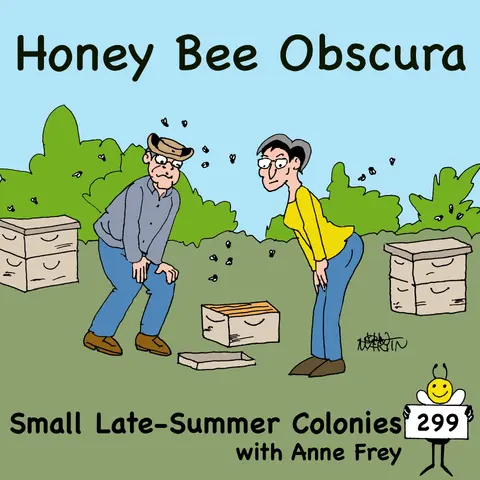
Jim Tew and Anne Frey discuss what beekeepers can do with undersized colonies heading into fall. From Varroa control, feeding and insulation to sharing resources, overwintering nucs, combining colonies and protecting valuable drawn comb, they explore practical ways to give small colonies their best chance of making it through winter

 Apple Podcasts
 YouTube
 Spotify
 Amazon Music
 Overcast
 Castro
 RSS Feed
 Late summer can expose the colonies that simply haven’t kept pace. Maybe they’re late splits, small nucs, colonies recovering from swarming, or colonies that never developed the population you expected. What should you do with them before winter?
In this episode of Honey Bee Obscura, Jim Tew welcomes Anne Frey of Betterbee for a practical conversation about managing small colonies as summer gives way to fall.
Anne and Jim discuss how small a colony can be and still have a reasonable chance of overwintering, along with ways beekeepers can improve those odds. That includes making sure Varroa mites are under control, providing adequate honey and pollen, donating resources from stronger colonies, reducing environmental stresses, adding top insulation, and positioning small colonies so they can benefit from shared warmth.
They also explore overwintering nucs above stronger colonies using double-screen boards, multi-compartment equipment, equalizing colonies with frames of capped brood, and when simply combining two weak colonies may be the better choice.
And what about moving colonies indoors—or even hauling them hundreds of miles south? Jim has stories about both.
The bottom line: small colonies require extra attention, realistic expectations, and sometimes a willingness to cut your losses while protecting valuable drawn comb for another season.
______________________

Thanks to Betterbee for sponsoring today's episode. Betterbee’s mission is to support every beekeeper with excellent customer service, continued education and quality equipment. From their colorful and informative catalog to their support of beekeeper educational activities, including this podcast series, Betterbee truly is Beekeepers Serving Beekeepers. See for yourself at www.betterbee.com

We’d like to thank Vita Bee Health for supporting the podcast. Vita provides proven tools for controlling Varroa—from Apistan and Apiguard to the new VarroxSan extended-release oxalic acid strips—helping beekeepers keep stronger, healthier colonies.

Thanks to Bee Culture, the Magazine of American Beekeeping, for their support of Honey Bee Obscura. Available in print and digital at www.beeculture.com
______________________
Honey Bee Obscura is brought to you by Growing Planet Media, LLC, the home of Beekeeping Today Podcast.
Music: Heart & Soul by Gyom, All We Know by Midway Music; Christmas Avenue by Immersive Music; original guitar music by Jeffrey Ott
Cartoons by: John Martin (Beezwax Comics)
Copyright © 2026 by Growing Planet Media, LLC

Episode 299 – Small Late Summer Colonies with Anne Frey
Jim Tew
Beekeepers is basically a fundamental goal of all other beekeepers and you to get the biggest hives we can, the healthiest hives, the most honey, the most pollination, the most everything. Well, the most isn't always possible. Sometimes you got the lesser producers, the smaller hives at the wrong time of the year. What are you gonna do with those? Anne Frey, I'm happy to tell you from Betterbee. Say hi, Anne. Hi, glad to be here. Anne's gonna tell us all about what to do with small hives
Anne Frey
What you said it was a conversation.
Jim Tew
Oh, it'll be yeah, it's just me telling the people what you're saying. No, what do with small hives right now? It's late summer goldenrod's just coming on. You got the last window, beekeepers, from most of us here in the upper Midwest, upstate New York. What do you want to do with this last window that we've got? I want to talk about that for a while. What do you do with a small hive? in the late summer, early fall. Beekeepers, I'm Jim Tew and I come to you here at Honey Bee Obscura once a week where today Anne Frey and I are going to try to talk about what to do with small hives in late summer, early fall.
Introduction
Welcome to Honey Bee Obscura, brought to you by Growing Planet Media, the producers of the Beekeeping Today podcast. Join Jim Tew, your guide through the complexities The beauty, the fun, and the challenges of managing honey bees. Jim hosts fun and interesting guests who take a deep dive into the intricate world of honey bees. Whether you're a seasoned beekeeper or just getting started, Get ready for some plain talk that'll delve into all things honey bees. Ann? Hi Jim.
Jim Tew
How's it going?
Anne Frey
It's going fine. We've got like you said goldenrod but I think ours is more like close to the peak.
Jim Tew
Yeah, mine's just starting. I'm gonna tell this the whole crowd the story and the last one of the last times Ann and I talked, she had a horrible cold. And she just coughed, cough, coughed. You seem a lot better today, Ann. Everything seems like it's going along better for you. Fingers crossed Fingers crossed. And do you have any small colonies you have to deal with now? As this is where you can be very prideful and say no, you keep your colonies strong. You never have small colonies, but if you had small colonies now What direction would you take?
Anne Frey
In a strange way, probably two-thirds to three-quarters of what we have is small colonies, 'cause that's the nucs. You know, those are seven to eight, possibly twelve frames, deep frames, but more likely they're eight. So those are small, but small on purpose. Are you talking about colonies that are having troubles or they had like an August swarm and therefore the remainder is small? Feel like that's what we're talking about.
Jim Tew
All those are options. Basically for whatever reason. I have a small hive right now, the last of August. I'm coming up on my final fall flow, which is never very good. It's never just really, oh my heavens, get back. This flow is really going strong So I'm probably going to have to combine do something, and that's what I'd like for us to talk about. What do you do with a small hive other than just let it die in the winter?
Anne Frey
Oh yeah, yeah. I wouldn't just do that because uh There's always a chance. We got the tiniest little colonies through the winter. One uh October we found a colony of just combs, uh some bees and a homeowner said, What's this up here? And we went and fetched it and I didn't have a lot of hope, but we put it above a large colony with a double-screen board as its floor. So we took off the inner cover and we put on a double-screen board. And then we put an inner cover, an outer cover on top of the little one. And they got all that warmth from the one below, maybe, you know, and humidity from the one below. They live through the winter. We gave them some honey on the sides as a donation from other hives.
Uh we did not give them any extra brood frames or bees. They just They just made it and they turned into a full-size hive the next summer. So that's one way. We didn't unite. We just sort of gave them a few things from the one below, the warmth and the honey. So there's an idea.
Jim Tew
Well the one thing you just described to me was patience. You had to wait almost a full season, a full year for that to turn into a meaningful beehive And there's no way to rush it.
Anne Frey
We waited from October to April to see how it did and then we moved it into bigger equipment and it got big on its own during that summer. So I'd argue that it was more like six months.
Jim Tew
Okay, well that's not bad. You still had patience, though.
Anne Frey
I'm pretty patient.
Jim Tew
What do you do now? Do you want to set up a hypothetical situation? I'm a beekeeper with ten hives and three are not winterable There are eight frames, ten frames at the most. Do I combine them? Do I double screen them and see if they can help each other or As a professional beekeeper, what would you do with three out of ten that were not going to make it on their own?
Anne Frey
Okay, so three out of those ten And each one is like eight frames of covered in bees?
Jim Tew
We'll just say eight frames, brood and bees, and they have got a recent queen, maybe it's a late swarm, whatever you want it to be.
Anne Frey
Yeah, I would make sure They were healthy. They their mites were dead. Make sure that they have frames full of honey and some pollen. You might have to find some from bigger hives to donate to them That's something I didn't know way, way back when I began was that you could just give donations. I just I was like, Well, will this hive collect enough for itself? That was the only thing I thought of as a way for bees to get supplies or me feeding them sugar syrup and that's valid too. You can make donations from donors, you know, if you have more than one hive. At the very least, I would shove them tightly together, and that might be awkward with telescoping outer covers, but you know, some kind of creativity with their covers.
And then They don't have cooled air on all four sides or all six sides, bottom and top two. Alternatively, you could stack them, like the double screen idea that I said and that you mentioned again then the top one has its entrance for one of those little spinny things on the double-screen board. I would definitely insulate the top or tops if they're side by side and You know, just give them every advantage, you know, take away every stress they could have if they're small colonies.
Jim Tew
What do you do with mites in these? When's the last mite check you would do? on a small colony in late August.
Anne Frey
Mite check. Well they're probably getting their treatment in late August or in the first week of September. I would advise people to do a mite check a few weeks after that. treatment is done, that would be the last mite check. But the small colonies, the big ones, we treat them all the same. Um every one of them gets a wintertime mite treatment too like around Christmas. What else are you gonna do on that week after Christmas when you're bored? So go take a walk in the winter and treat all your hives. So uh Yeah, I mean just the overarching idea of taking away every possible stress that any small or big one could have You know, like with little house plants or cuttings that you've made.
I always make this comparison when I give a talk. Those things, they need more babying, the small ones. You know, they're Their dirt gets dry faster. They can't deal with so much bright sun, you know. So same thing with little colonies. They need a little more babying. a little more frequent checks, that kind of thing.
Jim Tew
Yeah, you're describing a kitten almost.
Anne Frey
Well, sort of. Yeah. Or, you know You have a teenager, you know it's sort of self-sufficient, but when it's a toddler you take care of it more attentively.
Jim Tew
Yep, uh that's exactly right. And let's take a break and hear from our sponsor, and then we'll come back and talk about a subject that you said we have beaten to death.
Betterbee
For more than 45 years, Betterbee has proudly supported beekeepers by offering high-quality, innovative products, providing outstanding customer service, many of our staff are beekeepers themselves, and sharing education to Help Beekeepers Succeed. Based in Greenwich, New York, Betterbee serves beekeepers all across the United States. Whether you're just getting started or a seasoned pro, Betterbee has the products and experience to help you and your bees succeed. Visit Betterbee.com or call 1-800-632-3379. Betterbee, your partners in Better Beekeeping
Vita Bee Health
We'd like to thank Vita Bee Health for supporting this podcast. Vita provides proven tools for controlling Varroa, from Apistan to Apiguard to the new Varroxsan extended release oxalic acid strips, helping beekeepers keep stronger, healthier colonies
Jim Tew
Anne, do you winter those small colonies indoors or are they outdoors pushed side by side Or would you consider the I word, insulation?
Anne Frey
I thought you meant ibuprofen.
Jim Tew
No, you said we beaten that to death, but we have talked about insulation a lot.
Anne Frey
Yeah, yeah. I always consider insulation and it's a It's one of those things that's taking away a stress of the bees. Top insulation for sure. You know, people tend to go for that rigid foam board. they buy from a bee supply or from Home Depot and it seems like they buy it, that's the thickness of it, so they think of that as one and done. But I say, you know, put two thicknesses of that if you want. That's um I think it's R five, but the top is the most important part for insulation. I would use it three hundred and sixty five days a year too, but it's sort of annoying to have it in the bee yard when you take the cover off and it blows away.
Jim Tew
Well I'm really glad you said that and we weren't this is not a discussion of insulation, but I've wondered my house is insulated year round. Yeah, year round. Why wouldn't I have my beehives insulated year round? But now I'm officially off the subject We've gone off on a tangent. Yeah, but uh in the past, you know, I wondered best hottest blazes out there, they're having to keep it cooler inside. Wouldn't it help to be insulated? But I'm off the subject. Let's get back to the small hive thing. So you could consider insulating them if it came to it, but you don't winter and indoors, do you an upstate deal?
Anne Frey
No, that's a thing I would not consider doing. The insulation, definitely, I recommend doing it, but Wintering indoors, it's a easy phrase to just say, but for people in Canada, you know, or who knows Russia who winter indoors, it's a whole control the humidity, absolute darkness, or maybe red lights. For the humans who have to do things in there during the winter. It's not just pop it in your garage and say it's It's a big thing. You need air circulation. So no, I never really consider wintering indoors to be a thing. I think they have to have like a constant
Jim Tew
fifty that they had to stay there. And anything below that, they were too cold, and anything above that they become active. So it's not their thing to be indoors, but I tried it one time years ago and ironically we had hundreds of nuc boxes, two or three, four hundred of them And they were all flatboard covers with in cleats. They had no sides on them. They had no side cleats on the top, so we could push them side by side. Yeah, migratory covers. And I did bring those inside and out of I don't know, forty nucs or so, we might have gotten fifteen that survived, but basically it was death and destruction inside there and they were just Dead bees everywhere.
We didn't confine them. And then the mice came for the dead bees. This was just absolute chaos.
Anne Frey
Well you could call it a test
Jim Tew
No, yeah, it was a test, all right. It was a test of how to efficiently kill bees, apparently. No, I thought if you brought 'em indoors, you know, they'd be happy and they'd sit quietly by the fire and watch old T V reruns and wait
Anne Frey
makes them get all frantic. Yeah, I think in these barns that people in Canada store them in their doors are open and uh it's just dark, windowless, and you they have the machines running to keep the air proper and the air conditioning or heaters running. So The little colonies for us, I think it would be more like uh think of all the things they need. They need some food, they need some warmth. They need to be healthy. I think the smallest one that would probably survive would be three deep frames of bees covered with bees But there's also these uh you could put them in a deep box that has divider. You know, there's double of that style, there's even triple.
It's like a three chambers with two dividers and those would keep each other warm if there were only three frames of bees each. But there's a lot of ways of getting the bees to share their heat but not get together But thethere's also getting them together, uniting them. Like you said earlier. Should I combine them? Should I unite them? Sometimes just unite them.
Jim Tew
Yep. You lose a queen, but
Anne Frey
Yeah. It's hard to find a queen in a large hive at the end of summer, but it's probably pretty easy to find the queen in the small hive. But which one do you want to live? I don't think that you can always be so Picky if you're just trying to save a population of bees, you know, what is it? A thousand, two thousand bees you're trying to save, maybe six thousand. You're saving the comb Maybe saving the queen. You can make a split in the spring and you're back to two. Just get another queen. Or wait until swarm season and watch those uh swarm cells. Free queen.
Jim Tew
Well this is just you me and a listener talking here, but I don't understand the population dynamics here. If we go into to with a small number of bees, what would it be? Eight, ten thousand bees?
Anne Frey
Like ten thousand is about the size of a package, so that might be three or four frames covered with bees. Yeah, let's say ten thousand.
Jim Tew
So there's gonna be a winter die off. It's going to be a really small colony in the spring because it's going to have winter die off all winter. So I guess I would have to realize that if you go into winter with a small colony. Next spring you're going to have an even smaller colony, but at least it'll be alive and have a small patch of brood where they're trying to recover and they have good queen They can have really recovery dynamics. So managing small colonies is not the same as managing large colonies.
Anne Frey
even without any bees clinging on it from a hive that's bigger and can afford to give up that frame of capped brood, you've just given the little one 7,000 worker bees. Probably, you know, when it emerges, that might double the size or more than double the size of the recipient. Just picture it, all of them kind of on a little timer, ready to chew their way out, and you've got seven thousand more bees.
Jim Tew
But on the other hand, somebody defending the donor colony would say, well, you took 7,000 bees away from them. They did everything right, and their reward was to make a donation. to their needy brother colony.
Anne Frey
Maybe in a way it was a swarm prevention effort because that big colony was, you know, on a path towards overpopulating and swarming.
Jim Tew
You're right. Yep, that's exactly right. It's a balance. And there's one thing you haven't mentioned that I tried about a hundred years ago when I was a young man and would try such a thing. We made four single deep splits, eight frame, and we hauled, uh, must have been 200 all the way to North Florida and set them off on a farm field down there in North Florida. They were had a good amount of honey. I was in that area at Christmas. I checked them as best I could. I didn't have any honey to feed. But most of them were all right. And then we went back the next spring And I had early queens and we split those. They had wintered and survived okay.
And then we brought back a crazy number of beehives back to Ohio that for the most part prospered Except it cost about a million dollars to do it, not to count all the time that went into it. So if you looked at the financial logistics of it was terrible, but it worked okay.
Anne Frey
So you were making splits in the spring? Now in the fall?
Jim Tew
Right. We made splits in the fall. They were big splits. And hauled them to Florida. And then they wintered and then I bought early Queens, even farther south in Florida, if you could do that then. And then those colonies had built up reasonably well by the time I went down in preparation for the Ohio spring. They had ten or twelve weeks to build up. So then we made like splits out of those And came back. So that's one extraordinarily labor-intensive, almost pricey way to get a lot of bees from a small number of bees.
Anne Frey
That's way at one end of the spectrum. And that's just popping up.
Jim Tew
That's the other end of the spectrum.
Anne Frey
Yeah. Let's uh let's picture that bell curve and Jim Tew way at that end.
Jim Tew
Right. Yep. Me teaching economics and beekeeping.
Anne Frey
We're probably all mostly more in the middle where we would boost, um, equalize, put an insulation on and Give 'em a winter mite treatment.
Jim Tew
You've just given a good summary there about the only thing you can do is you know to I hate an old adage that's just worn out, but it's not rocket science. You just do basically what you can do. And then the last thing neither of us have mentioned, when the time comes, you go clean up the dead outs, save the equipment, and start all over again. And there will be dead outs
Anne Frey
you know, always be checking that equipment, the comb especially is valuable stuff. Just yesterday it turned out a hive had swarmed apparently and then Maybe it had swarmed repeatedly, but the population went down, it was starting to get robbed, and we just discovered it, and it was just on the beginning of having small hive beetles. So us being alert, we just saved a whole lot of comb by being able to grab that comb and put it in the freezer. You know, so be checking, be alert to all the possibilities of things going wrong We found that one just by looking at entrances as we roamed around the yard before mowing it. So be alert, save that comb, at least for four or five years.
It's not just saving the bees, it's it's like saving your stuff.
Jim Tew
Cutting your losses. Cutting your losses.
Anne Frey
Clean out those dead outs. Get them clean in the spring. so they don't get moldy. People see that mold on bees in the spring, um, dead and they say, Oh, moisture and mold killed my bees It's like, Well, d when you see a dead deer in a ditch, do you say that ditch killed the deer? But um yeah I didn't actually talk about dead outs. You brought up dead outs, Jim. That's a good way to end.
Jim Tew
That's a good way to end.
Anne Frey
Not really.
Jim Tew
You've given a good overview, Ann, so I can't really add anything to that. Our time is uh Up. Time's up. So as always, I enjoy talking to you. They're behind you. I appreciate him letting you use the facility while we co record there.
Anne Frey
I will. Yeah, I think we covered it. Till next time.
Jim Tew
Till next time. I hope there's next time real soon. Okay. Bye and bye-bye.

Beekeeper and Educator
Anne lives in Greenwich, NY and since 2019 has been Betterbee's Head Beekeeper, teacher, and videographer (catch her on Betterbee's YouTube channel!). She first got bees in 1989 while getting a Biology degree, and like most of us, she was a "bee-haver" for just a few years, until she became a member of her local beekeeping club (the Southern Adirondack Beekeepers Association, or SABA), where she learned a lot from members and through club activities.
Anne became invaluable to SABA's operation and led the Annual Seminar and Bee School for many years. Beekeeping associations are so valuable to us because of the speakers and events, but also because of the casual networking, support, and mentoring that comes about when people find a group near them.
She became an EAS Master Beekeeper in 2002 and is still learning to this day. In her limited spare time, she reads sci-fi and rides her bicycle.