Beekeeping in Hot Weather with Anne Frey (293)

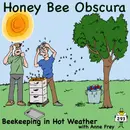
Hot Weather can be hard on beekeepers—but how hard is it on the bees?
In this episode of Honey Bee Obscura, Dr. Jim Tew welcomes Anne Frey of Betterbee for a practical discussion about managing honey bee colonies during periods of hot weather. Together they explore the differences between beekeeper discomfort and colony stress, why opening colonies during the hottest part of the day may disrupt carefully regulated hive temperature and humidity, and why simply observing the hive entrance can often be more valuable than another quick inspection.
Jim and Anne also discuss bearding behavior, ventilation, water needs, and the challenges of moving colonies during hot weather. A major focus of the conversation is how temperature affects Varroa treatment choices. Anne explains that different mite control products have different upper temperature limits and encourages beekeepers to become familiar with the available options so treatments can be matched to seasonal conditions rather than habit.
The conversation concludes with practical advice on providing water where natural sources are limited and considering how climate influences both honey bees and nectar-producing plants.
Whether you’re enduring summer heat in the South or experiencing unusually warm weather farther north, this episode offers timely, practical suggestions for helping both beekeepers and bees safely navigate the hottest days of the season.

 Apple Podcasts
 YouTube
 Spotify
 Amazon Music
 Overcast
 Castro
 RSS Feed
 Summer heat changes the way both beekeepers and honey bee colonies operate. In this episode, Jim Tew is joined by Anne Frey of Betterbee to explore what beekeeping in hot weather really means inside and outside the hive.
Jim begins by asking a simple question: are bees actually bothered by heat, or is it mostly the beekeeper who suffers? Anne explains that while honey bees evolved in warm climates and are remarkably effective at regulating hive temperature and humidity, beekeepers should think carefully before disturbing colonies that are already working hard to maintain those conditions.
The discussion highlights the value of simply observing colony entrances rather than opening hives unnecessarily. Entrance activity, pollen collection, fanning behavior, and bearding all provide valuable information while allowing the colony to continue regulating its environment.
Anne also shares practical guidance on managing Varroa mites during hot weather. Different mite treatments have different maximum application temperatures, making product selection especially important during midsummer. She discusses the temperature limitations of Formic Pro®, along with alternatives such as Apiguard®, ApiLife Var®, Apivar®, and repeated oxalic acid dribble treatments depending on colony conditions and local weather.
Jim and Anne finish by discussing water sources, climate differences across North America, and practical ways beekeepers can help colonies during periods of prolonged heat while avoiding unnecessary stress on the bees.
______________________

Thanks to Betterbee for sponsoring today's episode. Betterbee’s mission is to support every beekeeper with excellent customer service, continued education and quality equipment. From their colorful and informative catalog to their support of beekeeper educational activities, including this podcast series, Betterbee truly is Beekeepers Serving Beekeepers. See for yourself at www.betterbee.com

We’d like to thank Vita Bee Health for supporting the podcast. Vita provides proven tools for controlling Varroa—from Apistan and Apiguard to the new VarroxSan extended-release oxalic acid strips—helping beekeepers keep stronger, healthier colonies.
______________________
Honey Bee Obscura is brought to you by Growing Planet Media, LLC, the home of Beekeeping Today Podcast.
Music: Heart & Soul by Gyom, All We Know by Midway Music; Christmas Avenue by Immersive Music; original guitar music by Jeffrey Ott
Cartoons by: John Martin (Beezwax Comics)
Copyright © 2026 by Growing Planet Media, LLC

Episode 293 – Beekeeping in Hot Weather with Anne Frey
Jim Tew
Hey Honey Bee Obscura Podcast listeners. It's that time of the week again. You know, last week I gave you a heads up that I was going to talk more about this hot weather thing because it had been so hot this summer And I got a special treat.
I got Anne Frey here from Betterbee, who knows more about hot weather beasts than I do. She's got some late breaking info. Anne?
Anne Frey
Hi Jim. It was really hot last week.
Jim Tew
We want to talk more about that, just in general, and discuss some of the things that bees have a background in heat.
All you beekeepers in Alabama may be chuckling at us, so maybe it's just a personal thing as to what's hot. And what's not. That rhymed.
Anne Frey
That was kind of cute. That was a good one.
Jim Tew
Beekeepers and listeners, I'm Jim Tew and I come to you here once a week where we try to talk about something to do with plain talk, practical beekeeping.
Introduction
Welcome to Honey Bee. Obscura, brought to you by Growing Planet Media, the producers of the Beekeeping Today podcast. Join Jim Tew, your guide through the complexities, the beauty, the fun, and the challenges of managing honey bees. Jim hosts fun and interesting guests who take a deep dive into the intricate world of honey bees. Whether you're a seasoned beekeeper or just getting started, get ready for some plain talk that'll delve into all things honey bees.
Jim Tew
Anne I gotta tell you, and I've talked about it way too much, I guess this should be the old guys podcast, but heat when you're young is not the same as heat when you're old.
Anne Frey
Yeah. It seems like also when we're older we complain more, so uh a lot of things going on there.
Jim Tew
Don't get too personal now. Sure I complain, but it's my prerogative, isn't it? My knees hurt.
Well, I said we And do you have any thoughts to start this discussion? Because there's so much and so many applications and comments. That could be made.
Where's a good jumping in place?
Anne Frey
Well I think what you said before, like what's hot and what's not, it's like Do the bees care that it's hot? Does the beekeeper really care that it's hot? What are we talking about?
Is it how can the beekeeper do the work or is it should they even do that work at all with the bees that day. You know, for a lot of the time the bees don't care if it's it's hot on it's really just us. So uh We gotta work around it and consider especially temperatures when it comes to miticides.
That's the most important thing.
Jim Tew
That is the most important thing. As you were talking, does the hot weather Make the bees' physiological systems function more smoothly, the chemical reactions occur cleaner
Anne Frey
I'm not sure. Well, you know, they came from the tropics. It's an idea that the cold certainly the fall and the winter and the early spring is a stranger thing for the bees than constant warmth because they began as a tropical species. Whether it helps their bodily processes, I don't know.
Jim Tew
I'm wondering if we're sitting here pining and worrying about the heat when actually the bee is operating more smoothly. I don't know. I do know this. When I take a sting and and I'm hot, it really hurts a lot worse than I do when I'm out there cold.
Anne Frey
I hadn't even thought of how that feels when it's cold or hot. Wow, I can't even speak to that. I was thinking about things like them ventilating and people having jackets or bee suits and you know, and you're thinking about the stings. There's so many things
Jim Tew
Yes, there are so many things. There are. And a bit ago you said when it's hot and you're trying to manipulate bees, should you be?
And I just recently had my thought to myself that they've got a ventilation system going. They're maintaining control. And now I'm going to go in and destroy all that.
And I don't have any idea how long it takes a hot colony that's been disturbed to get back into the cooling business.
Anne Frey
Yeah, you bring that up pretty frequently, like each time we opened the hive we're disturbing them. It's really valid. You know, they've got their proper humidity, whether they've tried to make it less humid or more humid.
It's the proper temperature and they've worked to make it that way inside and we just open it up and do our thing and then close it up again and say goodbye. it's worth thinking about. You know, minimizing when you go in is is a style of some beekeepers and it's a really valid style I think if if you're not a beginner and have to learn things to just You could just leave them for three weeks or so before you come back for a check.
Jim Tew
I completely agree with you. There's uh a learning time. Where a beekeeper has to figure out that this is a normal looking brood pattern and this is how pollen's packed.
But after you've got the basic visuals and smells and senses laid to rest. I don't think you have to just go say, I'm just gonna take a quick peep. There's not many reasons for quick peeps.
Once you've got the basics done.
Anne Frey
True. But it is a a kind of fun thing if it's hot and you wanna go out, you could just maybe sit and look at the entrance or or something like that and you would learn something and you wouldn't have to have opened them up or put on your suit jacket. So I was had that on a little list of things a person could do when it's too hot to do beekeeping is just observe the entrance. See if they're bringing in pollen or no pollen. See if they're fanning how dense the population is at the door, etc.
Jim Tew
Well, I'm certainly a disciple of that. watching the entrance activity and I just love doing it. So sometimes I go back, not because I really care about the bees. It's just kind of Apicultural mindfulness.
Anne Frey
Yeah, you don't have to interfere all the time in order to learn stuff.
Jim Tew
You could just be a like a observer from afar. Let's talk about the bees matted out front. Hanging out the front. They'll sometimes go out just because it's too hot and sometimes they'll go out because it's hot and they're crowded. But no matter what, if they're hanging out front, that's gonna be a a more difficult colony to work, from my experience.
Anne Frey
Yeah, it seems like when they're hanging out instead of going to forage, they're sort of if I could act like they're humans, I would say that they're sort of frustrated in their their goal. They're just like, ugh we have to just hang here 'cause it's too hot to fly out and we're kind of annoyed about that, you know, and now there's this beekeeper. Let's get 'em, you know, so yeah, when they're hanging on in a beard, it does seem like they're they're just a little annoyed with life.
I agree with that. If it's humid and hot too, there's just gonna be Every little thing is gonna be more tough for the beekeeper. And you might start acting differently than you usually act when you're opening a hive because you're uncomfortable.
So It all adds up and then you'll be a worse beekeeper because you're not in a comfortable spot, if you know what I mean.
Jim Tew
I do know what you mean. Yeah, when I would go out at night to move bees either on a hot night or in the south where it was hot almost every night in the summer. And you see all those bees mattered out front.
It was just miserable, Anne, because you can smoke them back in. Smoke just scatters them. It doesn't entice them to go back inside the hive, but you've got to use smoke, and you end up just having bees everywhere.
So that's definitely a full suit glove night with duct tape at the ankles. Because there's bees crawling and bees all over the hive. Do you have that in upstate New York
Anne Frey
Well, we try as much as possible to just not move hives. It's uh the occasional we have to move them if a bear knocks them over or something like that, but we usually move them uh dusk or we leave behind one nuke or one hive to catch the field bees that are left flying, you know, moving 'em at night is not my idea of any kind of good idea. I'm just never want to move bees at night again.
I think the last time I did it was six years ago. Cross that off my list. We we just shouldn't even mention that as an option for people listening to this podcast.
Jim Tew
People don't move bees. Don't don't move bees. Yeah.
Yeah, just don't move your bees. I'm quoting Ann Fry on that. Don't move your hives.
It's too much work. It's definitely a two-person job. And I think you've got some information about hot weather management and might effects.
Can we take a break and then come back and pick up at that point? Yeah, sounds good.
Betterbee
Looking to re-queen a hive, make a split, or build your own nucs this season? BetterBee has mated queens available for shipment or pickup in Greenwich, New York. Choose for From Buckfast or hygienic queens, bred for hygienic mite resistance and strong honey production, gentle carniolan queens, known for managing hive populations with the flow, or better bees locally raised. Northern Queens, selected for winter hardiness, disease resistance, temperament, and honey production. Order your queens today at betterbee. com
Vita Bee Health
We'd like to thank Vita Bee Health for supporting this podcast. Vita provides proven tools for controlling Varroa. Apostan and apigard to the new VarroxSan extended release oxalic acid strips, helping beekeepers keep stronger, healthier colonies.
Jim Tew
All right, Ann, you're the one with the secret information. Let's have it.
Anne Frey
Yeah, Jim, I wanted to tell folks about the Better Be newsletter that recently came out and we have an article about treating mites in hot weather because some miticides you can't use them if they're any hotter if the temperature is any higher than eighty five. That would be Formic Pro Which I consider the best mitocide because it kills the mites that are inside the brood cells. But there's others that you can use like apergard You can use all the way up to a hundred and five degrees.
And by June in the south, people generally won't have a s their supers on. And then things like Apiguard. or ApiLife Var, which also has time all like Apiguard does.
You can use them as long as your supers are off. And they're a a higher temperature than Formic Pro down at 85. So there's options.
You can also use Apivar, you can use oxalic acid dribble repeatedly. I feel like friends of mine in the in the South sometimes they are at a loss to choose what to treat with because it's just too hot. And when you read all the instructions on each one of them, you realize there's a whole range of of high limits for different ones.
You can use, you know, just choose the one that's not too high
Jim Tew
I'm ashamed to tell you I hadn't really considered that that much. I just tend to use whatever I've got, and I tend to use it when I've got the time and the energy to go out and put it on. And I'd like to think that that's better than nothing, but apparently at times it might be worse than nothing.
Anne Frey
A mite count, an alcohol wash, and you feel like you must treat right now, you want a knockdown treatment But if it's just that you notice that the numbers are trending upwards and you know they're going to be high probably by the next count that you do, you may want to do a s kind of a s an ongoing treatment rather than a knockdown sort of flash treatment. So those are other choices besides the uh, you know, temperature choice. So I would say Formic Pro is more of a a knockdown flash sort of treatment and the other ones are they last for a month or two months.
They're more of a slow treatment of the mites that are on the bees' bodies and they're just kind of ticking along steadily. killing the mites as they emerge from the brood cells. They're not they're not that strong sudden treatment like Formic Pro is.
I guess I'm advocating people learn about all of them. We also have a a chart on our website that compares all of them and compares the price per treatment of a hive. So There's you know, it says like, do you have your supers on right now?
Is the colony uh this big or is it this big? Is you know, is it the temperature this or this and it just helps you choose it. Massachusetts MDAR also has a comparative kind of chart like that in pamphlet form, which is very similar, just really great to have it all in one place.
Jim Tew
Well Anne, that's absolutely amazing because that's where I was going.
Anne Frey
Oh yeah? I'm psychic
Jim Tew
You were giving so much information and I and some of the listeners would not be able to keep up with it. I just keep rolling along. So you just keep rolling along.
So that was going to be my question. Is all are some of your comments recorded someplace? Thank you for bringing it up And, you know, there is an irony here in this hot weather of hot climate, hot mic control, there are beekeepers right now who are fairly cool.
Are their bees in better shape than our hot weather bees?
Anne Frey
Oh, I thought we were gonna talk about cool beekeepers. You're talking about cool locations. Okay.
Yeah, there's there's places, sure, you know, up higher altitudes or just different states. I mean, this week for us is rather cool. Last week was record highs.
So yeah, things are Things are different in time, location. Do you think the bees are happier at a a middle temperature or would they be happier if they were all in the tropics still? That's what I was trying to ask.
Jim Tew
Are those bees in better shape? But you know you said early in this discussion that bees are tropical in nature.
Anne Frey
Oh they they used to be, you know.
Jim Tew
They've evolved. I guess it's a bit like me. I grew up in Alabama, but I'm not used to heat anymore.
Anne Frey
You've evolved. Bees have evolved
Jim Tew
Our engineer, Jeff Ott, who sets this up and cleans up all our befuddle comments here and makes it sound better than we are, made the comment that his bees and his climate has been remarkably cool. And I don't know how you would compare it. I don't know how what would you check? You know, what it's just a moot point. What would you check? Are cooler bees healthier, more productive than bees that are overheated?
And I guess you'd have to bring in the plants too. Are the if the plants are overheated, are they still producing nectar or is everything shut down?
Anne Frey
You know, nectar's a liquid, so I suppose if there was a drought, you know, or real dryness to the area, the plants would conserve their liquid and not give out the nectar. But that might be a very short term kind of reaction for a plant to do that. It It's probably more of a deep, you know, groundwater sort of a region wide reaction to what's in the soils, but the uh I think that the way you could measure it is are the bees thriving? You know, if they're struggling just to bring in enough nectar and pollen to keep a steady population, that's not thriving.
Jim Tew
You've been psychic the whole day today because of my last comment was going to be, what do you do about water? And you just mentioned water.
Anne Frey
Well We didn't prepare this ahead of time, you guys. It is really psychicness. I mean this is proof.
So the water is important if you live in a a city or s or desert. I I think that in general people like Jeff in Washington or us in Ohio or New York State, there's just pretty much always some dreams or ditches or ponds or rivers, you know, or rain every week and a half that soaks the ground. It's I don't feel that people in the country or in the suburbs need to provide any water, but city folks or maybe people closer to a desert or a you know, rooftop kind of things, they would they would be good to be providing water for their bees.
Less work for the bee to go find it if it's close, 'cause they'll go to the closest water source they can find.
Jim Tew
Well, you've just been knocking it out of the park today because I was going to make the comment in closing. Beekeepers in desert areas used to get a lot of complaints. from cattle farmers that they couldn't keep the bees away from the watering troughs. And the cattle couldn't water because there were thousands of bees there.
Anne Frey
Probably drowning in the trough. But yeah, I helped somebody set up his beehives in a new site one time, a new home, and he asked me for the the advice and he said uh there's a little pond and there's a swimming pool And I said, All right, set the beehives closer to the pond than the swimming pool. And he actually measured it out and put his stand and he said they never had them in the swimming pool.
It was just that it was more efficient for the bees to go the shorter distance to the pond. They they gotta have uh efficiency in how they spend their energy and That's our bees. They're efficient.
Jim Tew
Ann, give us the five major points that you would take from this segment today. We've covered a lot of ground about hot beekeeping.
Anne Frey
Five major points. I would say hot beekeeping, divide it between is the beekeeper hot or are you worried about the bees being hot? You should think about your knowledge of miticides and know when the limits of each type of mitocide are met on the high temperature when you can apply it. That's five, right?
Jim Tew
That's five. That's three.
Anne Frey
I think it's three or four. What else? Uh I think um Water provisions.
Jim Tew
You don't have to do it if you've got natural water. You should do it if you're in a hot climate.
Anne Frey
Yeah. That's five. No one does five things, Jim. People go by threes.
Jim Tew
People like number three. Okay. Anne, we're out of time.
You did a particularly good job today. I was just along for the ride. Thank you, Jim.
I gotta say goodbye now. Say goodbye.
Anne Frey
Goodbye, Ann.
Jim Tew
Okay. Goodbye, listeners. We'll see you next week. Bye-bye. See ya.

Beekeeper and Educator
Anne lives in Greenwich, NY and since 2019 has been Betterbee's Head Beekeeper, teacher, and videographer (catch her on Betterbee's YouTube channel!). She first got bees in 1989 while getting a Biology degree, and like most of us, she was a "bee-haver" for just a few years, until she became a member of her local beekeeping club (the Southern Adirondack Beekeepers Association, or SABA), where she learned a lot from members and through club activities.
Anne became invaluable to SABA's operation and led the Annual Seminar and Bee School for many years. Beekeeping associations are so valuable to us because of the speakers and events, but also because of the casual networking, support, and mentoring that comes about when people find a group near them.
She became an EAS Master Beekeeper in 2002 and is still learning to this day. In her limited spare time, she reads sci-fi and rides her bicycle.