Archive Special: Fall Feeding with Kim Flottum (298)
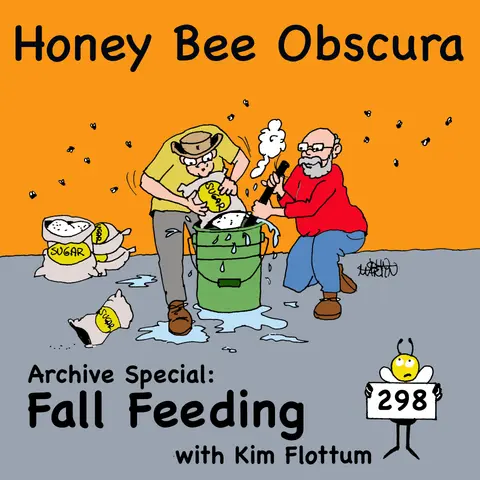
In this Honey Bee Obscura Archive Special, Jim Tew and Kim Flottum revisit the practical—and sometimes complicated—subject of fall feeding. They discuss why colonies may need supplemental food, sugar syrup ratios, fondant, dry sugar, feeder choices, winter honey stores, weighing and hefting hives, and the amount of work required to bring an underweight colony up to winter weight. Along the way, they remind beekeepers that feeding can help, but it is also important to understand why the colony became short on stores in the first place.

 Apple Podcasts
 YouTube
 Spotify
 Amazon Music
 Overcast
 Castro
 RSS Feed
 When should you feed your honey bees—and when is feeding simply masking another problem? In this Honey Bee Obscura Archive Special, we revisit a conversation between Jim Tew and the late Kim Flottum about one of beekeeping’s perennial fall questions: fall feeding of colonies in preparation for winter.
Kim and Jim begin with a deceptively simple question: Why are you feeding? A colony may need supplemental food because of poor forage, unfavorable weather, a newly created split, inadequate stores, or another management decision. But feeding can also become what Jim calls a “management Band-Aid”—something that helps a colony through a temporary shortage without addressing why it became short on stores in the first place.
From there, they tackle the practical questions. What should you feed? Thin or thick sugar syrup? Fondant? Dry granulated sugar? And with entrance feeders, top feeders, division-board feeders, and other options available, is there really one “best” method?
For northern beekeepers preparing colonies for winter, Jim and Kim discuss the amount of stored honey they historically looked for and an old but useful technique: weighing or “hefting” a hive to estimate its stores. They explain why learning what a properly provisioned hive feels like can help a beekeeper decide whether intervention is necessary.
Most importantly, they emphasize that meaningful fall feeding can require a significant commitment. Bringing an underweight colony up to adequate winter stores may require gallons of syrup—not simply feeding once and assuming the problem is solved.
The takeaway is classic Jim and Kim: feed when you need to, understand why you need to, and stop when the colony has what it needs.
______________________

Thanks to Betterbee for sponsoring today's episode. Betterbee’s mission is to support every beekeeper with excellent customer service, continued education and quality equipment. From their colorful and informative catalog to their support of beekeeper educational activities, including this podcast series, Betterbee truly is Beekeepers Serving Beekeepers. See for yourself at www.betterbee.com

We’d like to thank Vita Bee Health for supporting the podcast. Vita provides proven tools for controlling Varroa—from Apistan and Apiguard to the new VarroxSan extended-release oxalic acid strips—helping beekeepers keep stronger, healthier colonies.

Thanks to Bee Culture, the Magazine of American Beekeeping, for their support of Honey Bee Obscura. Available in print and digital at www.beeculture.com
______________________
Honey Bee Obscura is brought to you by Growing Planet Media, LLC, the home of Beekeeping Today Podcast.
Music: Heart & Soul by Gyom, All We Know by Midway Music; Christmas Avenue by Immersive Music; original guitar music by Jeffrey Ott
Cartoons by: John Martin (Beezwax Comics)
Copyright © 2026 by Growing Planet Media, LLC

Episode 298 – Archive Special: Fall Feeding
Jim Tew
Hey listeners. Here's a segment we enjoyed doing. It's an archive segment that we thought you would like to hear again.
Kim Flottum
Jim, have you ever had to feed your bees?
Jim Tew
Oh yeah I have, Kim. In the past. I've d had to feed quite a bit.
Kim Flottum
Well, you know, there's there's a lot of questions about feeding. And I'm people who haven't been doing this very long all kind of basically have the same sorts of questions. Hi, I'm Kim Flottum, and I'm here today with Jim Tew, and today we're going to be talking about fall.
Introduction
Welcome to Honey Bee Obscura, brought to you by Growing Planet Media, the producers of the Beekeeping Today podcast. Join Jim Tew, your guide through the complexities, the beauty, The fun and the challenges of managing honey bees. Jim hosts fun and interesting guests who take a deep dive into the intricate world of honey bees. Whether you're a seasoned beekeeper or just getting started, Get ready for some plain talk that'll delve into all things honey bees.
Kim Flottum
The first one that I get often is why are you feeding? Can't the bees take care of themselves?
Jim Tew
I'm going to have to struggle here too some. I feed to supplement the food they've got because I think it helps. Kim, sometimes I wonder if it just keeps me busy while my colony either dies or while it corrects its own problem.
Because what feeder? Right off the bat, if feeding was the right thing to do every time, we would have a feeder or two. That fits the bill.
But there's all kinds of feeders. Use a top feeder, use an entrance feeder, use a division-board feeder. If you're feeding liquid syrup, there's all of these different feeder models that you could use. So I never really know which one's the best, which one the bees learn to take it from, and by the time you get that figured out probably whatever the issue was that required feeding is pretty much passed.
Kim Flottum
Yeah, well, you know the There's kind of another side argument here is if your bees are unable to support themselves in the environment that you've put them. is it because the bees have a problem? Are they not healthy enough?
do they have issues that they can't forage enough to gather food, or is there not enough food out there? for them and in either case you're not taking care of them or you've put them in the wrong place. So why are you feeding is those I think that kinda goes to answer why are you feeding them?
They're in the wrong place or they've they've you've not taken care of them so that they're healthy enough to produce enough.
Jim Tew
Kim, can I call this a management band aid? If you have to feed, something else went wrong. Now maybe, maybe it was your shortage as a beekeeper.
Or maybe it was a shortage you expected, like you made a divide. And you knew that colony was going to be light in stores, and you didn't have honey to feed it, and you wanted to feed that small colony. While they got a jump start, and maybe you knew that you made that split at a time when there was no incoming nectar But maybe you knew that the season would be starting in just a week or two and that there would be incoming nectar.
So you applied a management band-aid to get the colony through these difficult times
Kim Flottum
That's a good way of looking at it. In the wild, if a colony swarmed in the spring, it would the swarm would be probably fairly small, and if it was healthy enough and there were enough bees in it, it would probably make it through the summer, but if it didn't, it wouldn't survive. So what you're doing is you're You are—I'm not going to say artificially swarming—, but you have produced another colony from the original and you are supplementing its food resources So that it does survive.
Jim Tew
Beekeeping and bees in the wild, in my opinion, are not bees in my hive at all. Bees in the wild will never have somebody come along and give them a piddling amount of sugar or some kind of other kind of carbohydrate or in some cases protein source. They're going to either have to live or die.
And this expected, apparently, instinctually, that a lot of those colonies in the wild are going to die. I don't want that to happen. I want my bees and my boxes to stay alive, so I'm going to put some feed in there.
Kim Flottum
So what do you feed when you feed?
Jim Tew
Let me think. Through the years, I've tried everything. I generally feed syrup.
Kim, do you heat the syrup because I generally feed thin syrup just because it's easier to make. That's not the right thing to do because someone like you is going to say, well, you're just giving them a lot of water, aren't you? Yeah, I am, but at least I gave them a little bit of sugar because if you've got the heat and add sugar, add sugar, add heat, add heat, add more sugar, stir, stir, stir, they're probably going to starve to death.
I'm probably never going to do that. So what do I feed? I generally feed a syrup as thick as I can make it with water as hot as I can get from the tap, and I understand that's probably not the best feed that I could have made.
But no, I don't try to get corn syrup of any kind. I d I do feed fondant a lot, but let's talk about that more in a few minutes. The syrup I feed is pretty thin right now.
Kim Flottum
Yeah, the you know, all the books will tell you know, to stimulate a colony to kind of get it going, up and going, you feed a one to one, a ratio of one part sugar to one part water. But if you're trying to feed it so that there's enough sugar there for them to store, then it's a two to one, two parts sugar to one part water. and a two-to-one mix is so thick it's almost difficult to stir.
Jim to make a one-to-one sugar syrup You gotta put in seventeen cups of sugar to a gallon of water. Seventeen cups.
And that's one to one. So to make a two to one, you're doubling that. Like I said, it's so thick you can almost you almost can't stir it.
So what you're doing is better than nothing. neither of us do what the books say to do. That two to one.
I've never made a sugar syrup two to one. because it's so hard to do. I'm you mentioned fondant I like using fondant.
Jim Tew
You know, in the old days, Kim, everything is in the old days to make things light, but there used to be recipes for making this fondant candy board. It with cream of tartar in it and all these kind of things. I I never did it.
I it looked like divinity that my grandmother would have made. Yep, yep. I've came I came across this fondant. I can give you the brand name, but I guess I won't. commercial fondant.
It's got it's got Corn, not corn, corn, corn flour. What is it? corn powder?
cornstarch. I'm sorry. It's got cornstarch in it And a lot of beekeepers don't like feeding that because it's indigestible to the bees apparently.
But is it so easy to put a glob of that stuff on there? And Kim, it's just heavenly. While you're working with that fondant, if you lick your fingers, it's just the sweetness of heaven to use that stuff.
So that way there's no mixing. It's pure sugar. It's just it's already there.
It's kind of, you know, pricey. You gotta go buy the stuff, but it's so easy to feed.
Kim Flottum
Yeah, it's and when you put ten pounds of fondant on you can be pretty sure you got almost exactly ten pounds of sugar in there and that makes comes down to about eight pounds, the equivalent of about eight pounds of honey. So I'm gonna I'm I'm gonna say that yeah, fondant for me is the best way to go. Sugar syrup is and you mentioned all those different kinds of feeders and every one of them works, but none of them work perfectly.
Jim Tew
Right. So many times in beekeeping, Kim, there's so many options. And I would like to suggest, without any proof, that if there's a lot of options surrounding a management procedure, That means that the jury is still out on what to do and how to do it.
Because if we had figured out the right way to control Varroa We wouldn't have all these right these other ways to do it. If we had figured out the best way to feed, we wouldn't have we wouldn't have ten feeder styles available to us. Number of queen cages you've got that you can choose from, something's not right with that.
So every step of the way, there's a lot of diversity and a lot of creativity that beekeepers Can use.
Betterbee
For more than 45 years, Betterbee has proudly supported beekeepers by offering high-quality, innovative products, providing outstanding customer service. Many of our staff are beekeepers. themselves and sharing education to help beekeepers succeed.
Based in Greenwich, New York, Betterbee serves beekeepers all across the United States. Whether you're just getting started, Or a seasoned pro, Betterbee has the products and experience to help you and your bees succeed. Visit betterbee. com or call 1-800-632-363-0. Betterbee, your partner in Better Beekeeping.
Vita Bee Health
We'd like to thank Vita Bee Health for supporting this podcast. Vita provides proven tools for controlling Varroa, Apistan, and Apiguard to the new VarroxSan extended release oxalic acid strips, helping beekeepers keep strong.
Kim Flottum
you know, I asked about f when to feed and you mentioned when you make a divide and y and you want that divide to make sure that it lasts as long enough that it can build itself up to be self-supporting. There's also a need for f feeding in the fall, so the bees have enough overwinter to store. How much how much honey should be in a colony we're in we're in northern Ohio. How much honey should be in a colony, say, the first of December when pretty much everything's done?
Jim Tew
You want a number? I'll give you a number. Yeah.
Sixty-eight pounds. And then there's okay all kinds of variables. Well, how much did the hive body weigh?
That's 68 pounds of honey, and that's going to be a gracious plenty I've read other that could go as low as 40 pounds, but it depends on the size of the cluster. And you know, where this thing is wintering. So, what I've been told through the years and what I have boldly repeated to beekeepers who wanted an answer was in Northeast Ohio 45 to 62 pounds of actual honey.
Which means that the colony would weigh a double would weigh something like 145 to 160 pounds if you weighed the entire colony.
Kim Flottum
Well, I was just gonna mention that. Is a way to tell how much how much food you've got stored in that colony is to weigh that whole colony. That's simply use a spring scale on the front Record that weight.
Use the p hook it on the back, record that weight, add the two together, and I've always said 150 pounds. Just most exactly what you just said. So if you've got a colony with two deeps, ten frames, bottom board, inner cover, and cover, 150 pounds is going to give you about 50 to 60 pounds of honey.
Jim Tew
So if you don't have that. Feed but Kim, you know, but this is this is more conversation than instruction Feeding's kind of thing that there's something else wrong. If you and if you just feed a time or two or three, you probably just prolong that colony's death, unless, just like you said at the first of the start, there was a reason for it.
So f when you feed, if you're trying to feed for winter supplement, that's a significant undertaking. That's going to be gallons and gallons, because we're talking one colony. When you said one gallon of syrup What if you got 30 colonies and there's 30 gallons of syrup times 17 cups per gallon?
And all of a sudden, this is a big job. So it's a lot of work to feed, and it takes a lot of commitment to keep feeding, enough to get the job done at a meaningful level.
Kim Flottum
And then you gotta figure out again, I'll go back to where we started. Why you're why are you having to feed? Is it because there isn't enough food available or because there's something ailing the bees that they're not able to collect enough?
And That you that brings you back to that problem. You gotta solve that problem. Why isn't there enough?
Jim Tew
Have you said dry sugar? Dry granulated sugar? I've done it. It's a mess. And how did you feed it?
Kim Flottum
I just I sprinkled it on the inner cover, around the inner cover hole opening, and I think they carried as much out and dumped it on the ground as they ate.
Jim Tew
Well, I've done that too. And I think that they carry it out and dump it on the ground as soon as they can. I think they probably eat some of it.
I think the main thing it does, Kim is it makes me feel like that I did something as a beekeeper. And I didn't just stand by while that colony idly starved. So if I let that colony go into winter really light and I go out and do the tip test on the back and that colony is easy to tip.
It's nowhere close to a hundred and fifty pounds total. Then I have these anxiety attacks, can't doze off at night worrying about that colony, and I'll go out there and pour a pound and a half of sugar around that inner cover hole and feel like that somehow I've done my part.
Kim Flottum
When I've when I was way back when, that was the test. If you could lift it needed food. If you couldn't lift it from the back, then it had enough food.
And I always looked at that and said, okay, I'm just tall, skinny guy and next to me is this guy who's a professional wrestler when he was in high school. Why What what how do you compare the two? This guy picks the colony up with one hand and puts it under his arm and walks away and I can't budge the thing.
Hefting was always kind of unknown to me.
Jim Tew
Well, you gotta learn your own heft, Kim. That was I was a tall, skinny guy I would never was all that tall. I was always skinny and lightweight.
unlike now where I'm still kind of short and heavyweight, but the hefting thing was a relative thing. What's a heft to me would not be a heft. to that wrestler.
Everybody has to learn their own weight thing.
Kim Flottum
Yeah. That weighing front and back to me is spot on in terms of being able to decide if there's enough food in there. And then if you don't know You know, then you have to look, but it saves you looking at a it saves you having to look at a lot of colonies.
Jim Tew
Kim, at times you have to f at times you have to feed. But probably you're feeding because you want to try to help the colony that's in trouble. Why it got in trouble?
Yeah. It's what we've tried to discuss and some of the things you can do to help them get out. But feeding is not always the end-all solution.
But it is something that the beekeeper can do in their arsenal, in their toolbox of management suggestions. You can feed to help this colony. Sometimes it helps.
Sometimes it just lets the colony linger a while longer before its den still comes around.
Kim Flottum
Yep. And I guess when that weight gets to where you want it, it's time to quit and or there's enough snow on the ground that you can't get to the colony anymore, so and you're just done. Yep, just done.
Jim Tew
Yep. Alright, so feed if you have to, and then stop feeding when you can.
Kim Flottum
There you go.
Jim Tew
I guess. Thank you, buddy.
Kim Flottum
Take care.
Jim Tew
Let's talk again next Thursday about something just to stimulate. Thanks. Thanks to all these folks who bought up listened this long. We deeply appreciate you doing.
Kim Flottum
And if you got questions, don't hesitate to send them in. Go to our webpage and there's a spot there that you can ask us a question. We're looking for questions.
Jim Tew
Bye.