Plain Talk: Hive Tops and Winter Thoughts (268)
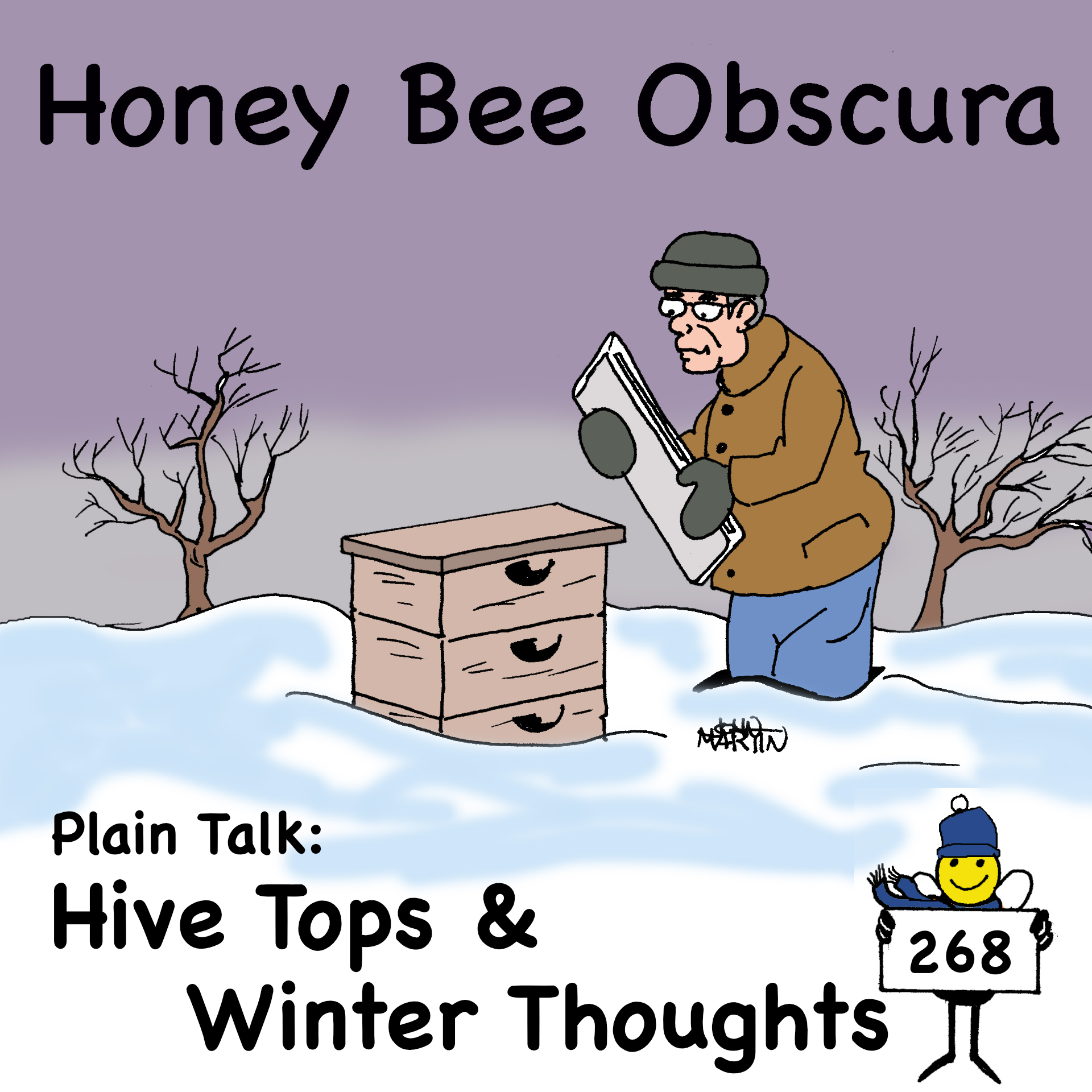
As winter storms move across much of North America, Jim Tew reflects on beekeeping, weather, and the realities of starting over. From insulation choices and equipment decisions to aging as a beekeeper and adjusting expectations, this episode offers thoughtful, honest plain talk for anyone managing bees in cold conditions.


In this Plain Talk episode, Jim Tew records from his shop as a major winter storm approaches, using the moment to reflect on beekeeping, weather, and long-term planning. He shares a personal story about storms, preparation, and unpredictability before turning his attention to the coming season and what lies ahead for his apiary.
Jim discusses plans to rebuild his colonies after winter losses, including ordering packages, establishing a single outyard, and returning to what he calls “traditional beekeeping,” with a renewed focus on insulation and colony comfort. He walks listeners through recent equipment choices, including insulated inner covers, winter feeding options, and the challenges of managing moisture and heat retention during extreme cold.
The conversation also touches on adopting modern tools such as hive sensors, balancing old-school practices with new technology, and making practical decisions about foundation, equipment reuse, and labor as a solo beekeeper. Throughout the episode, Jim reflects on aging, changing goals, and the humility that comes with starting over—again.
As the storm settles in, Jim closes with a reminder to stay safe, look out for one another, and remember that beekeeping, like many pursuits, is a continual process of learning, adapting, and beginning anew
______________________

Thanks to Betterbee for sponsoring today's episode. Betterbee’s mission is to support every beekeeper with excellent customer service, continued education and quality equipment. From their colorful and informative catalog to their support of beekeeper educational activities, including this podcast series, Betterbee truly is Beekeepers Serving Beekeepers. See for yourself at www.betterbee.com
______________________
Honey Bee Obscura is brought to you by Growing Planet Media, LLC, the home of Beekeeping Today Podcast.
Music: Heart & Soul by Gyom, All We Know by Midway Music; Christmas Avenue by Immersive Music; original guitar music by Jeffrey Ott
Cartoons by: John Martin (Beezwax Comics)
Copyright © 2026 by Growing Planet Media, LLC

Episode 268 – Plain Talk: Hive Tops and Winter Thoughts
[music]
Dr. Jim Tew: Hey, listeners. I always start these podcasts unintentionally with something to do with the weather, but today, this really is the weather. I mean, practically everyone I'm talking to right now is going to be in the middle of one of the storms that's coming through here in late January. Listeners, I'm taking back to an old story years ago. There was a tornado on tap for coming through Auburn University, where I was. Well, as is so often the case with tornadoes, they're always predicted. I take them seriously, and when they touch down, they're horrible, but most of the time, they just don't do anything.
I'm not being arrogant. I'm not being presumptuous, but as a young man, I had the idiotic thought that this would be a good time to go get a haircut, because nobody would be there. I suspect this is going to blow over the way it always does, and point of fact, it did. I went and got a haircut, and there was no one there. As I was sitting there, the woman said, "What would possess you to come out? Don't you know there's a tornado coming?" I said, "Well, yes, I did know that there was one coming, but I assumed there wouldn't be anybody here waiting. I was right."
At the time, listeners, I had a head full of hair. Boy, you can't look at me now and tell it, can you? She was snipping with a pair of large scissors, almost shears, and I, at the same time, felt and heard her catch the back half or a quarter inch of my earlobe and snip right through it. She was a nervous wreck about the storm, and then she cut me, and I bled like I was dying. She was trying to hold it. Blood was running down out of the palm of her hand. She was asking an associate for help. They came over, and they tried to put Band-Aids on me and get the bleeding stopped and clean up my neck.
She finished my haircut, and, you know, listeners, she charged me full price, and the storm did not touch down, and that's how that story ends. If you have any questions about going to get a haircut in the middle of a storm, I would recommend against it because the hair people are remarkably nervous and want to be in the basement, sitting back by the furnace or something in the safety area. Why am I telling you this? Because we've got this storm coming, and I probably should be rushing to the grocery store buying milk and eggs and whatever, but I decided this should be a good time to do a podcast.
For those of you who are listening to this later, you have to be where we are now. By the time you listen to it later, you're going to know how this all ends up, but at this point in time, we don't know, so I thought it's a good time to come out here as I just wait for Mother Nature to do whatever she's going to do.
[music]
I thought it'd be a good time to come out here and talk to you about my spring plans because I know that my bees are going to be dead. Listeners, I'm Jim Tew. I've come to you here at Honey Bee Obscura, this podcast where I try to talk to you once a week about something to do with plain talk beekeeping.
Introduction: Welcome to Honey Bee Obscura, brought to you by Growing Planet Media, the producers of the Beekeeping Today podcast. Join Jim Tew, your guide through the complexities, the beauty, the fun, and the challenges of managing honey bees. Jim hosts fun and interesting guests who take a deep dive into the intricate world of honey bees. Whether you're a seasoned beekeeper or just getting started, get ready for some plain talk that'll delve into all things honey bees.
Jim: I feel like Sisyphus, who was relegated to the underworld as punishment for some devious sin to roll that huge rock up the hill, and just as he'd get to the top, the rock would roll back, and it was all to do over again. How much like that is beekeeping? Before I get all sappy about beekeeping, how much like that is gardening or farming or woodworking or anything? Everything is a process of starting over again, maintaining, and whatever.
The difference is when I used to have a lot more colonies, I essentially could reseed myself. Now, as an older beekeeper, and I guess I would almost have to admit a lazy beekeeper too, I don't have enough seed bees to really start over again. Just as soon as I could get a reading. I'm going to place my order for packages and maybe a split or two. I'm going to try to follow my old advice. It is as though I'm starting over again. I'm a new beekeeper because I'm as old as I've ever been trying to do this, so there's some differences there. I'm going to start. I hope to get five to 10 colonies this year.
Then I've told you in a previous podcast, I've got this interest in having one outyard, not the 15 or 20 that we used to have, but just one outyard so I can have places to go to look at, enjoy, and talk to you about my bees. While I was at that big meeting, lobby, the North American Honey Bee Expo, saw a lot of people there. With this on my mind, I bought some of these insulated inner covers because even though I've told you in previous podcasts, I'm going to open this, that I'm going to not be able to do all the new beekeeping and the fancy beekeeping that could be done. I'm just probably going to go back and do what I'm calling traditional beekeeping, that I've always done with a caveat.
I would like for these colonies to be more insulated than they are right now. Now, I know there's colonies called condensing hives and all that, but I don't have an opinion on that right now. I don't know. The main thing I do know is that it's cold out there right now. It is very cold, and those bees are just in a wooden box. I didn't take off a bit of honey. What I've got is from a company named BeeSmart, and it's an insulated cover like I've never seen before. It's out of the box. It's a two-piece component. Oh, wow. It is an insulated cover. It's expanded polystyrene in what amounts to being a deep inner cover.
It has a feeder hole in the middle. It says, "Notice instructions are below the insulating sheath." If I get that out. How do you catch it? There it comes. Pull out the insulation. Fits very tightly and nicely, and yes, there are some instructions. There's a cap on what would have been the center handhold. There's finger grips. There's the outer cover that goes over the insulating pad. The insulating pad is basically just a deep inner cover. If you use this without the insulation, you can open up the small hole so that the bees can get up in the top. Could you use this as a feeder?
Could I feed dry sugar at the top? Seal top, upper tarp, middle top? "Other winter options, mountain camp feeder, add a shim under the insulated cover, and then lay newspaper. Candy board, make a candy board, and install under the inner cover." Yes, you could use it as an inner cover. You could use it as a quilt box, but I think I would just use the insulated pad that came with it, and it'll take the Beehive Smart Feeder. I'm not trying to sell these components. I'm trying to insulate hives better. We had Anne Frey on one of the podcast quite a while back, and she said that she can go out any time of the year and put insulation on. You don't have to do it in the fall.
Well, I don't have it, but if you folks have insulation and you think your bees are cold, Anne from Betterbee said that she can go out and put that on, no matter how late in the year it is. At many times, you might as well just do it in January or February and not try to do it in November. Speaking of Anne and Betterbee, let's take a break and hear from them.
Betterbee: For more than 45 years, Betterbee has proudly supported beekeepers by offering high-quality, innovative products, providing outstanding customer service, many of our staff are beekeepers themselves, and sharing education to help beekeepers succeed. Based in Greenwich, New York, Betterbee serves beekeepers all across the United States. Whether you're just getting started or a seasoned pro, Betterbee has the products and experience to help you and your bees succeed. Visit betterbee.com or call 1-800-632-3379. Betterbee, your partners in better beekeeping.
Jim: I'm going to have to do more reading on this. It looks like that I could cut a hole in the top here and could use the top feeder that I've already got from this company. It looks like that this deep box could be any number of things. I can close it off, I can push out the plug, and it's like it's the inner cover handhold, or I can put the plug back. There's drain holes here. Overall, I only bought four of these, and I'm not testing. I don't want to test. Push that back in, so now it's back to an insulated cover. I don't know what it's going to do about holding water because that plastic is not going to be permeable for anything, but I'll give it a shot and see. I've got four of those.
The second thing I got was a gift, of all things, from this webinar, a BroodMinder. I got it at a time in life where I couldn't do much with it because of my personal issues, but now this is on top for next year. Even though I'm an old-fashioned beekeeper, I'd like to use as much electronics as I can just so I can be a lazy beekeeper. I can sit inside and use my phone app. I don't know if BroodMinder is supportive of lazy beekeepers, but I'm going to add that to it just because I think, as a beekeeper who doesn't want to open the colonies any more than I have to, that this would be a good way to go.
I've got to put time in this, too. This is a list of things that is going to require some work from me to get this understood, to see how this works out. Do you see where I'm going with it, that I could use this to help me understand what's happening inside the hives? It's odd because I'm using fairly modern technology to do fairly traditional beekeeping. Here we go. Go ahead and write me. If I could, I don't mind wiring frames, but I just bought 100 new frames. I sat there and thought about buying 100 sheets of old-fashioned foundation and wiring and whatever.
Listeners, I couldn't do it. If you just pelt me to death, if you just do nothing but beat up on me, I will go buy some old-fashioned foundation and eyelet the frame in bars and wire it and do it just so I don't ostracize everybody. In the heat of battle, I just bought 100 sheets of foundation, of the plastic center inserts. Even though I've asked a lot of questions about those things. Are they too thick? Do they affect the way the bees winter with that thick midrib? Does it affect heat transfer in the colony, or does it help? Maybe that center mass there, once you heat it, like the cement floor here in my shop, is good for holding heat. I don't know.
Either way, me buying the plastic foundation inserts is not a comment on those of you who are still buying classic beeswax foundation and wiring and embedding the wires, that's the good way to go. I don't disagree with it, but I'm a one-man band, and I'm remarkably behind. The other thing in a perfect world that I'd like to do next spring is I bought one of the pressure washer sprayers that you use to clean your walkway, your driveway with a common pressure washer. I bought it because I'm a beekeeper. I bought everything because I think that might have a use in beekeeping.
What I want to see is if I can take those old foundation inserts and run over them with that pressure washer. Now, the foundation sheet's going to go crazy. I probably got to figure out some way to temporarily attach it to a board or weight it down some way. I don't know how I'm going to do it. Then see if I can clean all the old residue with a pressure washer of off that foundation sheet. Then I want to see if I can recoat it in beeswax and reuse it.
I guess by telling you that story, I've just antagonized the people who want me to be looking more at the old-style technique of foundation, embedding, and wiring. Anyway, this new thing is here to stay. I don't know much about how to repurpose or reuse those old foundation sheets. I'm expecting my bees to be dead. I'd like to buy five to seven in a perfect world, 10 colonies, but that's going to be a fair amount of money. Fair amount of money. I've got other things I want to buy, too. I'd like to just keep these colonies more insulated. The perpetual question that I've asked on the podcast before, and I still don't have a good answer for it, is insulation seasonal?
My house is insulated year-round, so that when the air conditioner is running, it helps keep the inside cool and the outside heat away. Does the same thing work with a beehive? Does insulation work year-round, or does insulation come off as soon as winter is over? I know there's people who's going to say, "Well, the sun warms the hive up and wakes the hive up, and all that, and that's probably right," but I'd like to do more about the insulation and get my bees back in order better. There is one fatal flaw that I just can't overcome is I keep using deeps because I have so many new deeps knocked down that I inherited from my dad.
I've got plenty of those products, so I'm going to be using that. The problem that I'm expecting is that I'm going to have a lot of dead bees, maybe even all of them. I thought this last year, but this has really been some coldness now. I keep thinking about people who listen to these as back stories, and you'll probably be listening when it's in August or something, and you can't conceive of what it's like to be sitting here right now with it being 3 degrees above 0, going down to 15 below, and my bees were not prepared for this. I don't know how you prepare bees for that kind of coldness other than just really having them disease-free, food in the right place, maybe insulated, protected from the wind, and whatever. There's, of course, ways to do it.
People keep bees in cold climates all the time, but they were better prepared than I am, and probably were better beekeepers for cold-weather beekeeping than I am. It looks like it's going to be a cold winter, and I've enjoyed buying the equipment and going to the meetings. I just had to cancel a meeting. I'd like to say I want to try to make it up to the group. I'll tell you more about it later, but it was right in the path of the storm, and I was just too insecure about the weather and traveling alone to take it on.
I'll try to make it up to that group and tell you more about them. They're a good group of people training new beekeepers. That's the plan. I wonder what your plans are. I wonder what your storm plans are. I'm just talking to you. I'm not talking to all of you. I'm just talking to you. Yes, you. You be careful with this weather. Don't get caught outside. If you're a first responder, my heart goes out to you because it's going to be tough. If you're an electrical worker who's in high demand to get the lines back up after the ice takes them down, my heart goes out for you, too.
[music]
That's all I got. I'm going to stop here. I enjoyed talking with you on this cold afternoon. I'm going to have a simple dinner tonight, eat by myself, and just enjoy having, I hope, a warm house and a safe place to hide from the storm. I wish you all the best. I wish all of you all the best. A lot of us are in harm's way. I wish all of us the best. Stay together and be strong. I'm Jim, telling you bye.
[00:19:55] [END OF AUDIO]
