Plain Talk: NAHBE Reflections (267)
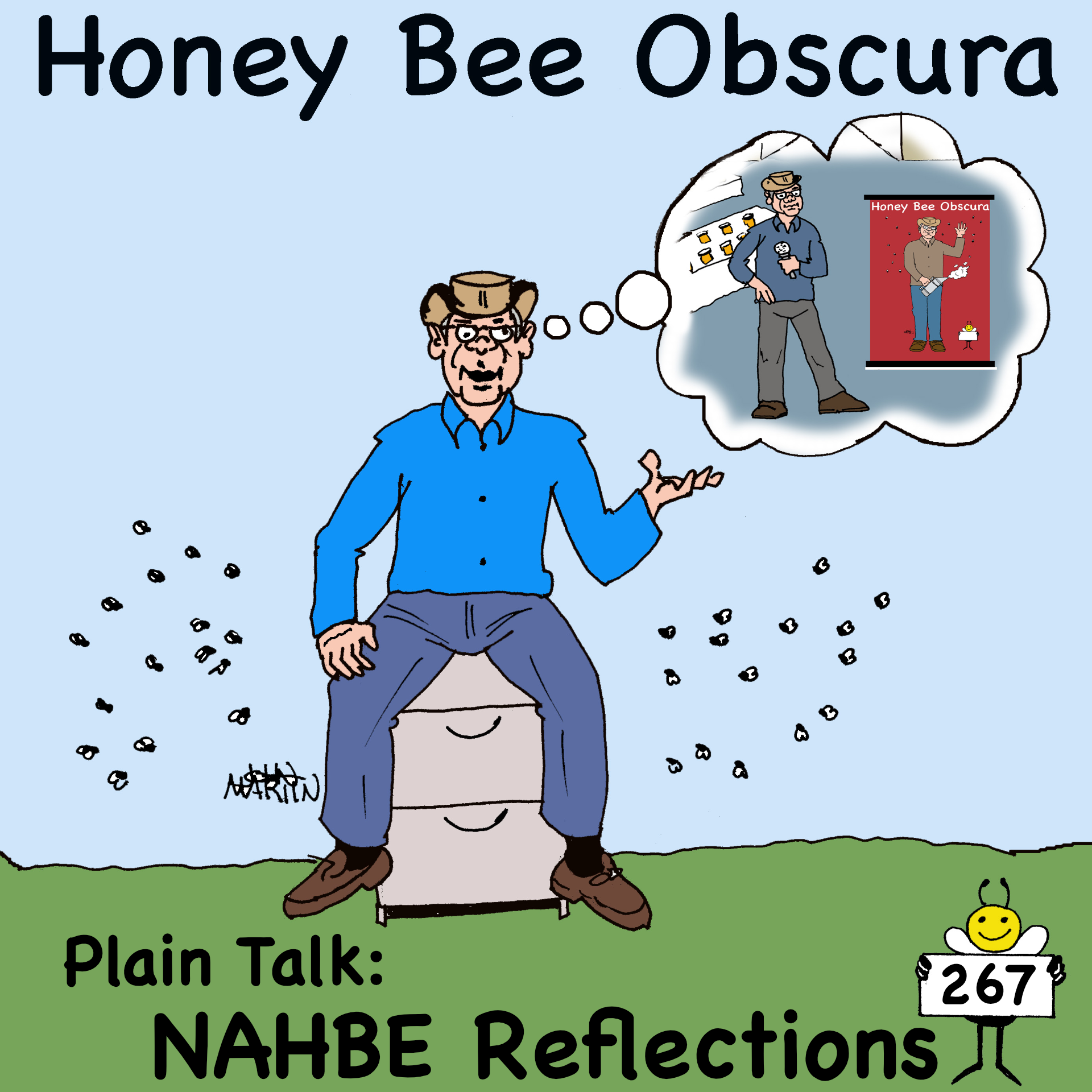
What happens when a lifelong beekeeper walks the floor of a modern beekeeping expo and realizes just how much the craft has changed? In this Plain Talk episode, Jim Tew reflects on NAHBE, innovation fatigue, and finding renewed meaning in simplicity and community.


In this Plain Talk episode of Honey Bee Obscura, Jim Tew shares thoughtful reflections following his recent experience at the North American Honey Bee Expo. Walking the show floor, Jim was struck not only by the size and energy of the event, but by how dramatically beekeeping equipment, ideas, and approaches have evolved over the years.
Jim revisits pivotal moments from his career—early encounters with Africanized bees, queen rearing efforts, international travel, and decades of teaching—and contrasts those experiences with the sheer volume of new hive designs, protective clothing, and management philosophies now available to beekeepers. The pace of innovation, he observes, has reached a point where no single beekeeper can realistically absorb it all.
Rather than seeing this as a problem to solve, Jim introduces the idea of stepping back. He reflects on what he jokingly calls “retrogressive beekeeping”—choosing familiarity, simplicity, and practices shaped by experience rather than novelty. At this stage of life, the joy of beekeeping comes not from chasing every advancement, but from understanding one’s limits and embracing what remains meaningful.
Equally important were the personal conversations Jim had with listeners. Meeting beekeepers face-to-face, hearing their stories, and receiving their encouragement reminded him that beekeeping has always been as much about people as it is about bees. This episode is a quiet, honest meditation on aging, change, and rediscovering purpose within a community that continues to grow.
______________________

Thanks to Betterbee for sponsoring today's episode. Betterbee’s mission is to support every beekeeper with excellent customer service, continued education and quality equipment. From their colorful and informative catalog to their support of beekeeper educational activities, including this podcast series, Betterbee truly is Beekeepers Serving Beekeepers. See for yourself at www.betterbee.com
______________________
Honey Bee Obscura is brought to you by Growing Planet Media, LLC, the home of Beekeeping Today Podcast.
Music: Heart & Soul by Gyom, All We Know by Midway Music; Christmas Avenue by Immersive Music; original guitar music by Jeffrey Ott
Cartoons by: John Martin (Beezwax Comics)
Copyright © 2026 by Growing Planet Media, LLC

Episode 267 – Plain Talk: NAHBE Reflections
Dr. Jim Tew: Hey, listeners. It's me, Jim, here at Honey Bee Obscura. I'm reflecting, and I don't really know how to get a parameter or a grip or a hold on my multivariate thoughts, but I'm going to try, so please bear with me. Even though in a few minutes I'm going to say that I talk about plain talk beekeeping, I'm not sure anything about this session will be plain talk beekeeping, but I'll do it as best I can. Listeners, I'm Jim Tew, and I come to you about once a week here at Honey Bee Obscura, where I always try to talk about something to do with plain talk beekeeping.
Introduction: Welcome to Honey Bee Obscura, brought to you by Growing Planet Media, the producers of the Beekeeping Today podcast. Join Jim Tew, your guide through the complexities, the beauty, the fun, and the challenges of managing honeybees. Jim hosts fun and interesting guests who take a deep dive into the intricate world of honeybees. Whether you're a seasoned beekeeper or just getting started, get ready for some plain talk that'll delve into all things honeybees.
Jim: There have been pivotal times in my life, but specifically, there have been pivotal times in my bee life. All those years ago, when I got sent to South America, and for the first time, I fully realized what Africanized bees were and how different they were. That was pivotal. I didn't know what we were going to do with those bees if we had to deal with them. That was pivotal. That was a point where you said beekeeping is at a juncture here, and I don't know where it's going to go. The first time I raised a queen, I felt like a new father. The first time I successfully instrumentally inseminated queens, I felt like I was a scientist who had come of age.
These were pivotal moments. When I traveled the world, not to try to impress you, but I've been to some strange places, every one of those locations, every one of those trips were pivotal, and they broadened and changed and shaped me. This past weekend, I was at the North American Honey Bee Expo, NAHBE. I would have to say that was a pivotal experience for me, and this podcast, Honey Bee Obscura. Beekeeping Today is the other podcast, and it's established and fixed and has its reputation in place. My discussion, Honey BeeObscura, I have learned to fly without Kim Flottum, and I've become alone.
Anne Frey is a frequent visitor here, and I have some other visitors, but more often than not, I'm just talking to you. Not to all of you at once. I'm just talking to you. At this meeting, you people came out of the woodwork. You see, right now, I'm doing it right now. I am energetically and passionately talking to the walls in my shop. I've got the fluorescent tubes turned down. I've got the refrigerator in quiet mode, and I've got my phone turned off just to keep it quiet so we can sit here and have this private conversation. I've never seen anything like this meeting that I was just at, and it shocked me on several levels.
The energy, the number of people, the diversity of programs, and the setup seemed to flow along to me as a vendor nicely. Number one, it really showed me and let me tap into the vibrant energy that is alive and well right now in beekeeping. I'm doing my best not to keep going back to the last three to four years of my life, but they were dark, difficult times, with my wife's health failing, and I had been out of the game. This was just energizing to me, very selfishly, to go back and see all this energy, all this enthusiasm, all these people who, in many cases, knew me before the dark times and reminded me of trips to Pennsylvania and Connecticut, New York.
All the other things that were good memories, they brought them back. We're all in the same boat. Then all my stars, there was all of you new people. When I talked to you, I'd feel like your grandfather or something. Let me tell you a story about when I was a little boy in beekeeping, kind of thing. The first pivotal moment was a reinvigoration of my appreciation and energy for beekeeping, so much as a man of my age can be reinvigorated and re-energized. It was really a pleasant experience. Secondly, or thirdly, or fifthly, or whatever it is, as I had the opportunity to walk around the equipment exhibit area, I realized once and for all that I can never sample everything in beekeeping ever again.
There are really interesting hive styles and designs, techniques, equipment, protective gear. I've told you time and time again that protective gear, when I started beekeeping in the early '70s, was a painter's suit with really no modification, just a white painter's suit with a veil that you tied on with cord on some kind of pith helmet. The veil was made out of metal window screening that would rush through after you perspired through it twice. The gloves were gardener gloves that the bee supply companies had added gauntlets to. I talked to the ladies back in the sewing machine rooms who were making gauntlets every day and sewing them onto gardener gloves.
That was our protective gear. Then the smokers, of course, the smokers in these old days were just like the ones you have today, except they had a heat shield around them that was lined with, guess what, asbestos. Those are all gone now. It was a solid heat shield around the smoker. The smokers today have the wire rack that you could get your fingers through if you worked at it and really burn yourself, but basically it protects you from touching the hot barrel. That was it. The hive tools often had Werner printed on them, W-E-R-N-E-R, because they made window-opening devices for woodworkers and homeowners, and we just modified them to use them for hive tools.
When I walk around and look at the absolute marvelous clothing designs and equipment and new styles of smokers and things that were there, you think, "Yes, you're an old guy." You do that crackly, mingling voice where you say, "When I was a boy, this is not what we did. We used to make our own gear." It is absolutely stunning. The second pivotal point that I had to experience was I don't have life's energy, and I don't have enough money to try every option that's available to you and me out there now.
You see these advertisements, and you see these things inside the bee catalogs and wherever. You just really don't know exactly what you're looking at. To see it, touch it, pick up a brochure on it, see how this would work, see someone else's clever idea, that was pivotal. Let me catch my breath and organize my random thoughts here. Let's hear from our sponsor that we appreciate very much.
Betterbee: For more than 45 years, Betterbee has proudly supported beekeepers by offering high-quality, innovative products, providing outstanding customer service, many of our staff are beekeepers themselves, and sharing education to help beekeepers succeed. Based in Greenwich, New York, Betterbee serves beekeepers all across the United States. Whether you're just getting started or a seasoned pro, Betterbee has the products and experience to help you and your bees succeed. Visit betterbee.com or call 1-800-632-3379. Betterbee, your partners in better beekeeping.
Jim: The third pivotal point for me brought about by this meeting was something I have named retrogressive beekeeping. When I see all this modern equipment, all these designs of hives, and whether or not they're condensating hives, or all the newness and the vibrancy, I have to realize that I am probably more comfortable going backwards than I am going forwards because backwards in beekeeping was simple. On a wild day, you could actually build your own hives if you had scrap lumber or any lumber.
I realized how dated I am. Before I just go buy everything, and the reason this is a shock for me is because when I worked for Ohio State, I had a budget, I had expectations put on me that I would be somewhat of an authority in areas like this. If a new piece of equipment came out, a new hive design was out, I would probably at some point purchase it, have a look at it. Not for evaluating, but just being able to answer questions and be informed. Those days are gone, listeners. There's too much newness. There's too much vibrancy. I'm sitting here in a stuffy, filled-up little shop now. Where would I put all this stuff, even if I bought it?
I'm at a place in life where I should be dumping, not acquiring. If I practice retrogressive beekeeping, to me, that just means that I'm the beekeeper I always was, using the equipment that I've always used. Now, I know that that woodenware I use could be helped by some insulating barrier on the top of it, maybe even underneath it, and certainly on the walls of it. There's things I can do with my retrogressed beekeeping, but I want to have the latest, greatest, new hive design. I really want you people to do it. I want you people to enjoy. Those of you who have the time and the energy, and the financial resources to explore and to keep beekeeping evolving and changing.
I'm saying that it looks to me like, for a 77-and-a-half-year-old guy, that I'm going to do what I know how to do, and I'm going to depend on the rest of you to tell me essentially what I'm missing. Our hive design that I'm talking about right now, it was not chosen. I've said in other seminars and other segments, it wasn't chosen because it was great for the bees. It was chosen because it was a good place, good efficient way for lumber production and for lumber cuts. Scrap off a cut, maybe if they're cutting down a deep, could be used as the rim on the outer cover of the top.
They were trying to minimize waste. Nobody surveyed the bees and said, "Is this what you want?" It was an economy of cut. I realized that when I see some of these new hive designs, that maybe they are trying to incorporate some of the sloping hive designs or whatever. The top bar hive thing is still alive and well. I didn't see the Warre Hive represented at this meeting. Maybe it was there. The meeting was so large. It was perfectly possible to miss something. There's a lot of new plastic hive designs, hard plastic, expanded polystyrene plastics. New hive designs, lots of information on condensation inside the hive, and whether or not it's a good thing.
Second, third point, I don't know which point I'm at. My pivotal point is that beekeeping is too high-speed, too advanced, too sophisticated for me to try to stay on the varsity team. I just want to have a good time in beekeeping, have my quiet bee yard that I've talked to you about so many times, and stay in that line of work. That was important to me. That was meaningful. I'm still in beekeeping, I still enjoy it, and I really enjoyed talking to you. That was the next pivotal point. You people who came to that meeting and came to me as a person, that was remarkably significant to me from a very selfish standpoint.
People were very gracious to me, like I had information, like I had skill, like I had something. That was beneficial to you. I wish I did. If I did, I would happily have given that information out. I deeply enjoyed meeting all of you. There was a lot of you now. There was a lot of you, but I'm only talking to you one at the time right now because it overwhelms me mentally to try to think that you're talking to a lot of people, no? No, I'm not. I'm talking to one person right now. I'm talking to you, to you. If you, do I dare say this because I would not want to leave anyone out or offend anyone, do I dare say this?
If you're so inclined and you've had a picture made with me, maybe I would like for you to send me that picture along with your name. Not that I'm going to do anything with it. Just so when I'm having these sessions like I'm having right now, that I may have a list of names and people that I've actually met and spoken with. You were all gracious. The people who don't like what I do and the people who are not particularly happy with me didn't say anything to me. I appreciate that because I'm not real strong in life right now. The people who are okay with what was going on were very supportive and very courteous.
The third or fourth, or fifth thing pivotal for me is meeting the people who listened to this podcast and said that they enjoyed, they appreciated, they drove to work, whatever. I thank you for that. That meant a lot to me. I wish I could remember every one of you with clarity, but in all honesty, there was a lot of you. I appreciate every one of you. I've come back late in the beginning of the year. Every year, like everybody else, I lay down some resolutions. They're pretty much the resolutions from the previous year. My resolutions from the last four years now have been really muddled. I'm going to start taking a bit better care of my beehives.
This was based on this trip, on the reinvigoration of my psyche, and the awareness now that we're pretty much getting through January, February is cold, and then it's time to start thinking about spring. I should order some packages or some splits because once again, I expect I'm going to have some dead hives. I'm going to put them in equipment. I bought frames. I bought wooden frames. I'll see if I can get those things assembled. Maybe I'll take you over to my wood shop on one of these episodes, and we'll put together frames, which is always mind-numbingly boring after you do it several hundred times.
I think I'll freshen my equipment some. Here's a real peculiar thing. I think I'd like to have one more outyard. Right now, I've cut down. I used to, when I was at Ohio State with my dad and brothers, sometimes had 25, 15, 25 locations for bees. Now I have one that I can walk to visit, but I think I want one more. Since I don't have anybody to tell me to get my life under control and breathe in a bag, I think I'd like to maintain a few more colonies. I don't know. I don't think I'll go straight to 20 in one year, but I wouldn't mind being up close to 20 again and just having enough bees to play with.
Then, as I'm winding down, here, I've got this retrogressive thing. I've got a real quirky idea I'm considering. Segment's long gone, and I didn't think to look up the segment. I talked about an antique box hive that I was given that was built from plans in a farm journal somewhere back around 1840. I think that I'm going to rebuild that box hive. If I don't get in trouble with the state of Ohio, because it's not science, but it is observational science, I guess it's a kind of citizen science. It's not replicated.
I don't think I'll have an actual control hive beside it, but I want to see if I can rebuild that hive, let the bees do their own thing, lay out their own brood nest. Jeff, the IT engineer for this podcast, said, "Why don't you put in sensors and probes and see what the readings and the weight gains are inside this natural bee nest colony?" I said this "This is the kind of thing that I'd plan to do and then never do it. I'm hoping that by telling you that this is something I would be intrigued by, because I love bee biology, that I'll add that to my to-do list. I had a very, very good time. It was a meaningful time.
It was an awakening after some darkness that I've been through, and it was an awakening. I deeply appreciate all of you people who helped me wake up and come back to the goodness and the excitement and the enjoyment of beekeeping. Stay in touch with me. I'm going to try to be better about communicating with you than I have been because I've been bad, but I'm going to try to communicate with you better. You all mean a lot to me. I appreciate your support and your listening to this podcast. I'll talk to you again next week about who knows what. I'm Jim, telling you bye.
[00:22:03] [END OF AUDIO]